Watch Servicing: How Often, What It Includes & Where to Go

---
Your mechanical watch contains over 100 components working in precise coordination. Lubricants degrade. Gaskets age. Microscopic wear accumulates with every tick. Proper servicing isn't optional maintenance: it's what separates watches that last generations from watches that fail prematurely.
This guide covers everything you need to know about keeping your watch running properly for decades.Watch Service Costs by Brand (Singapore 2026)
| Brand | Official Service (S$) | Independent (S$) | Interval |
|---|---|---|---|
| Rolex | 800-1,500 | 400-800 | 10 years |
| Omega | 600-1,200 | 350-700 | 5-8 years |
| Patek Philippe | 1,500-5,000+ | Not recommended | 3-5 years |
| Audemars Piguet | 1,200-3,000+ | 800-1,500 | 4-5 years |
| Cartier | 500-1,500 | 300-600 | 5-7 years |
| TAG Heuer | 400-800 | 250-500 | 4-6 years |
| Tudor | 500-900 | 300-600 | 5-7 years |
| IWC | 700-1,500 | 400-800 | 5-7 years |
Official vs Independent Service: Which to Choose?
| Factor | Official Service | Independent |
|---|---|---|
| Cost | Higher | 30-50% less |
| Parts | Genuine guaranteed | Usually genuine |
| Warranty | 2-year service warranty | 1-year typical |
| Turnaround | 4-8 weeks | 1-3 weeks |
| Resale impact | Positive | Neutral to negative |
| For investment pieces | Recommended | Avoid |
| For daily wearers | Optional | Good value |
Why Watch Servicing Matters
A mechanical watch movement operates continuously at 28,800 vibrations per hour (or more). That's over 250 million beats annually. The components achieving this are smaller than grains of rice, operating with tolerances measured in microns.
The lubricants reducing friction between these components don't last forever. Over time, they degrade, evaporate, or become contaminated. When lubricants fail, metal contacts metal directly. Friction increases. Wear accelerates. What starts as slightly degraded timekeeping becomes permanent damage to irreplaceable parts.
Modern synthetic lubricants last longer than the animal and vegetable oils used historically, but they still have finite lifespans. The question isn't whether your watch needs servicing: it's when.
Service Intervals by Brand
Manufacturers provide recommended service intervals based on their movements' design, lubricants used, and expected operating conditions. These recommendations have generally lengthened as lubricant technology has improved.
| Brand | Recommended Interval | Notes |
|---|---|---|
| Rolex | 10 years | Increased from 5 years in 2015 for modern movements |
| Omega | 5-8 years | Annual water resistance check also recommended |
| Tudor | 5-7 years | METAS-certified models may extend slightly |
| Patek Philippe | 3-5 years | Complex complications may require more frequent service |
| Audemars Piguet | 3-5 years | Royal Oak recommended every 4-5 years |
| IWC | 5-7 years | Depends on model complexity |
| Cartier | 5-7 years | Tank and Santos models |
| Breitling | 4-6 years | Chronographs may need more frequent attention |
| TAG Heuer | 4-6 years | Calibre-specific recommendations vary |
| Grand Seiko | 3-4 years | Spring Drive movements may differ |
| Jaeger-LeCoultre | 4-6 years | Reverso and complex models need regular attention |
| Panerai | 4-5 years | Submersible models may need more frequent seal checks |
Understanding These Intervals
These are guidelines, not guarantees. Several factors influence when your specific watch actually needs service:
Usage patterns: A watch worn daily experiences more wear than one worn occasionally. Daily wearers should service at the shorter end of recommended intervals. Environmental exposure: Watches regularly exposed to water, dust, temperature extremes, or magnetic fields may need earlier attention. Dive watches used for actual diving should have water resistance checked annually regardless of full service timing. Movement complexity: Chronographs, perpetual calendars, and other complications have more components and more points requiring lubrication. They typically need service more frequently than time-only movements. Watch age: Vintage movements (pre-1990s) often used different lubricants and materials. Many require service every 3-5 years regardless of manufacturer recommendations for modern calibres. Storage conditions: Watches stored in humid environments, extreme temperatures, or near magnetic sources may need earlier service even if worn infrequently.What Happens During a Full Service
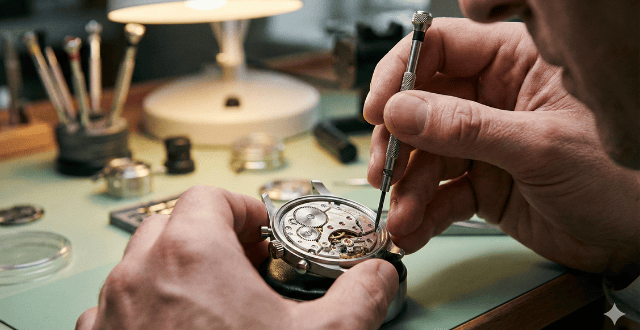
A complete watch service (also called an overhaul) follows a systematic process designed to restore the movement to factory specifications. While specific procedures vary by brand and model, the general sequence is consistent across the industry.
Pre-Service Assessment
Before disassembly begins, the watchmaker:
| Step | Purpose |
|---|---|
| Visual inspection | Document case condition, crystal clarity, dial condition |
| Timing test | Measure current accuracy, amplitude, beat error |
| Water resistance test | Check if seals are compromised (pressure test) |
| Functional test | Verify all features operate (crown, pushers, date change) |
| Magnetic field check | Detect if movement is magnetised |
This assessment establishes baseline condition and identifies any issues beyond normal service requirements.
Complete Disassembly
The movement is removed from the case and completely disassembled. Every component is separated:
- Mainspring removed from barrel
- Gear train dismantled
- Escapement disassembled
- Balance wheel and hairspring removed
- All bridges and plates separated
- Jewels cleaned or replaced if damaged
For chronograph movements, this includes the complete chronograph mechanism: coupling, hammer, levers, and chronograph wheels. Complex movements may have 200+ individual parts.
Cleaning
All components undergo ultrasonic cleaning in specialised solutions. This process:
| Stage | Solution | Purpose |
|---|---|---|
| Pre-clean | Solvent solution | Remove old lubricants and gross contamination |
| Main clean | Ultrasonic cleaning fluid | Remove microscopic debris from all surfaces |
| Rinse | Clean solution | Remove cleaning fluid residue |
| Dry | Controlled heat/airflow | Prevent moisture retention |
Parts are handled with brass tweezers or vacuum picks to avoid contamination from skin oils. A single fingerprint can compromise a cleaned component.
Inspection and Part Replacement
Each component is inspected under magnification. Worn parts are identified and replaced:
Commonly replaced during routine service:- Mainspring (loses elasticity over time)
- Gaskets and seals (crown, caseback, pushers)
- Click spring
- Yoke spring
- Worn pivot jewels
- Balance staff (if bent or worn)
- Hairspring (if damaged)
- Pallet jewels (if chipped)
- Gear wheels (if worn)
- Hands, dial, crystal (cosmetic)
Authorised service centres use genuine manufacturer parts. Independent watchmakers may use genuine parts (when available) or quality aftermarket equivalents.
Lubrication and Reassembly
This is the most critical phase. Each component must receive the correct lubricant, in the correct quantity, at the correct point.
| Lubricant Type | Used For | Characteristics |
|---|---|---|
| Light synthetic oil (Moebius 9010) | Balance pivots, escape wheel, high-speed components | Low viscosity, minimal friction |
| Medium oil (HP 1300/Moebius 9104) | Barrel arbor, centre wheel, lower-speed components | Higher viscosity, greater staying power |
| Escapement grease | Pallet stones, escape wheel teeth | Thixotropic (cushions impact, flows smoothly) |
| Mainspring grease (Moebius 8200) | Mainspring coils | Prevents coils sticking |
| Silicone grease | Gaskets, crown threads | Maintains seal flexibility |
A typical mechanical movement has 30-50 individual lubrication points. Each must receive precisely the right amount: too little causes dry running and wear; too much causes spreading, contamination, and performance issues.
Testing and Regulation
Once assembled, the movement undergoes extensive testing:
| Test | Specification | Purpose |
|---|---|---|
| Timing (6 positions) | Brand-specific (e.g., Rolex: -2/+2 sec/day) | Verify accuracy across all wearing positions |
| Amplitude | 270-310 degrees typical | Confirm healthy power delivery |
| Beat error | <0.5ms | Verify escapement geometry |
| Power reserve | Manufacturer spec (e.g., 70 hours) | Confirm mainspring and gear train health |
If timing is outside specification, the watchmaker adjusts the regulator (on regulated movements) or the variable inertia weights (on free-sprung movements) until performance meets standards.
Case and Bracelet Refinishing (Optional)
Many services include cosmetic restoration:
| Service | Process |
|---|---|
| Case polishing | Restore brushed and polished surfaces to original finish |
| Bracelet refinishing | Remove scratches, restore link surfaces |
| Crystal replacement | Replace scratched sapphire or acrylic |
| Lume reapplication | Restore luminous material (rarely done on luxury pieces) |
Final Assembly and Water Resistance Testing
The movement is cased, and final checks performed:
- Case sealed with new gaskets
- Bracelet reattached
- Final timing verification
- Water resistance testing (wet or dry method depending on rating)
- Final inspection under magnification
The watch is returned with documentation of work performed and warranty coverage on the service.
Signs Your Watch Needs Service
Don't wait for complete failure. These symptoms indicate service is due:
Timing Issues
| Symptom | Likely Cause | Urgency |
|---|---|---|
| Losing 30+ seconds/day | Degraded lubricants, magnetism, worn parts | Service soon |
| Gaining 30+ seconds/day | Magnetism, hairspring issue | Check immediately |
| Erratic timekeeping | Multiple possible causes | Service soon |
| Stopping overnight (when worn daily) | Power delivery issues | Service needed |
Mechanical Symptoms
| Symptom | Likely Cause | Urgency |
|---|---|---|
| Crown feels gritty or stiff | Contamination, worn stem | Service soon |
| Crown won't screw down fully | Cross-threading, worn gasket | Service needed (water resistance compromised) |
| Date doesn't change at midnight | Calendar mechanism issue | Service needed |
| Chronograph won't reset to zero | Coupling or heart cam issue | Service needed |
| Rotor sounds excessively loud | Worn rotor bearing | Service soon |
Visual Symptoms
| Symptom | Likely Cause | Urgency |
|---|---|---|
| Condensation under crystal | Seal failure, water ingress | Emergency: service immediately |
| Dial discolouration | Water damage, age | Assess damage, likely service needed |
| Second hand stuttering or jumping | Escapement issue | Service needed |
| Hands loose or fallen off | Dropped or impact damage | Service needed |
Service Costs
Service pricing varies significantly based on brand, movement complexity, and service provider. The following ranges provide general guidance for Singapore in 2026:
Authorised Service Centre Pricing
| Brand/Model Type | Typical Service Cost (S$) |
|---|---|
| Rolex (time-only, e.g., Oyster Perpetual) | $800-1,000 |
| Rolex (Submariner, GMT-Master) | $1,000-1,400 |
| Rolex (Daytona chronograph) | $1,200-1,800 |
| Omega (Seamaster, Speedmaster) | $600-1,000 |
| Tudor (Black Bay) | $500-800 |
| Patek Philippe (time-only) | $1,500-2,500 |
| Patek Philippe (complications) | $3,000-8,000+ |
| Audemars Piguet (Royal Oak) | $1,500-2,500 |
| Cartier (Tank, Santos) | $600-1,000 |
Independent Watchmaker Pricing
Qualified independent watchmakers typically charge 30-50% less than authorised service centres:
| Service Type | Typical Cost (S$) |
|---|---|
| Basic service (time-only, ETA/Sellita) | $200-400 |
| Full overhaul (Rolex) | $400-700 |
| Full overhaul (Omega) | $350-600 |
| Full overhaul (complex chronograph) | $500-1,000 |
| Water resistance check only | $30-80 |
| Magnetism removal (demagnetisation) | $20-50 |
Authorised vs Independent Service
Authorised Service Centres
| Advantages | Disadvantages |
|---|---|
| Genuine manufacturer parts guaranteed | Higher cost |
| Brand-trained technicians | May replace "acceptable" parts unnecessarily |
| Service warranty from manufacturer | Longer turnaround times (4-12 weeks) |
| Maintains brand service history | May refuse service on modified watches |
| Authenticates watch during service | Less flexibility on cosmetic choices |
- Watches under warranty
- Investment-grade pieces where provenance matters
- Complex complications requiring specialist knowledge
- Situations where brand service history affects value
Independent Watchmakers
| Advantages | Disadvantages |
|---|---|
| Significantly lower cost | No manufacturer warranty on service |
| Faster turnaround (1-4 weeks typical) | Parts sourcing may be challenging |
| More flexibility on vintage pieces | Quality varies significantly between providers |
| Won't refuse modified watches | May use aftermarket parts |
| Can discuss specific preferences | Less formal documentation |
- Daily wearers where cost-efficiency matters
- Vintage watches where authorised service is unavailable
- Modified watches rejected by authorised centres
- Situations where budget is primary concern
Finding a Qualified Independent Watchmaker
Not all independent watchmakers are equal. Look for:
| Qualification | Why It Matters |
|---|---|
| WOSTEP certification | Indicates formal Swiss watchmaking training |
| Brand-specific training | Shows exposure to manufacturer standards |
| Experience with your brand/movement | Familiarity reduces risk |
| Proper equipment | Timing machines, ultrasonic cleaners, pressure testers |
| Clear communication | Willing to explain work and discuss options |
| Warranty on service | Confidence in their work |
Request references. Ask about their experience with your specific calibre. Visit their workshop if possible to assess professionalism and equipment.
Where to Service Your Watch in Singapore
Authorised Service Centres
Rolex Service Centre Singapore- Address: 302 Orchard Road #01-01 Tong Building, Singapore 238862
- Phone: +65 6737 9033
- Note: The only official Rolex Service Centre in Singapore. Appointment recommended.
- Omega maintains authorised service capabilities through The Hour Glass and other authorised retailers
- Contact Omega boutiques at ION Orchard, Marina Bay Sands, or Takashimaya for service booking
- Service through respective brand boutiques or authorised retailers
- Cortina Watch, The Hour Glass, and Sincere Fine Watches handle service for multiple brands
Independent Service Options
Several reputable independent watchmakers operate in Singapore. These are referenced in collector communities and have established track records:
Global Watch Service Centre- Swiss-trained technicians with 30+ years combined experience
- Services most major Swiss brands
- Official service centre for Maurice Lacroix and Dunhill
- Multiple locations
- Family-owned since 1995
- Founded by former Rolex watchmaker Henry Lim
- WOSTEP-certified watchmakers
- Services from S$800 for full overhaul
- Swiss-trained technical team
- 16+ years experience
- Rolex servicing from S$600
- Services major luxury brands including Patek Philippe and Audemars Piguet
- Located at Tanjong Katong Complex
- Services Rolex, Omega, Seiko, and ETA-based watches
- Recommended in collector forums
- Open 2pm-9pm
Maintaining Your Watch Between Services
Proper care extends service intervals and preserves your watch's condition.
Daily Habits
| Do | Don't |
|---|---|
| Wind manual watches gently and consistently | Overwind or wind roughly |
| Screw down crowns fully before water exposure | Assume water resistance without testing |
| Rinse after saltwater or pool exposure | Leave salt/chlorine residue on case |
| Store in stable, moderate humidity | Store in extreme heat, cold, or humidity |
| Wipe down with soft cloth after wearing | Use chemicals or abrasives to clean |
Storage
| Recommendation | Reason |
|---|---|
| Store in watch box or roll | Protects from dust, scratches, and impact |
| Keep away from speakers, phones, magnets | Prevents magnetisation |
| Maintain moderate humidity (40-60%) | Prevents gasket degradation and condensation |
| Store automatic watches on winder (optional) | Keeps lubricants distributed; not essential |
| Keep original box and papers | Maintains value and service history |
What Watch Winders Do (and Don't Do)
Watch winders keep automatic watches running by simulating wrist movement. They're convenient for watches with complex calendar functions that are tedious to reset. However:
- Winders don't eliminate service requirements
- Continuous running may marginally increase wear
- Quality winders with proper rotation settings are essential
- Poor-quality winders can damage movements
Avoiding Common Mistakes
| Mistake | Consequence |
|---|---|
| Setting date between 9pm-3am | Can damage date mechanism |
| Operating chronograph underwater | Can breach water resistance |
| Exposing to strong magnets | Causes accuracy issues (often fixable) |
| Ignoring water ingress signs | Causes permanent movement damage |
| DIY repairs without training | Often causes more damage than it fixes |
Service Records and Documentation
Maintaining service records matters for both watch health and value.
What to Keep
| Document | Purpose |
|---|---|
| Original purchase receipt | Proves authenticity and ownership |
| Warranty card | Required for warranty claims |
| Service receipts | Documents maintenance history |
| Work order details | Records specific work performed |
| Part replacement records | Shows what was changed and when |
Impact on Value
Complete service history positively impacts resale value, particularly for:
- Vintage watches (proves continuous care)
- Investment-grade pieces (Rolex, Patek Philippe)
- Watches with complex movements
- Recently serviced watches (buyer confidence)
A watch with documented authorised service history typically commands 10-20% premium over identical pieces without records.
FAQ
How long does a watch service take?
Authorised service centres typically require 4-12 weeks depending on brand and workload. Some brands quote 8-16 weeks for complex movements. Independent watchmakers usually complete work in 1-4 weeks. Always confirm estimated turnaround before committing your watch.
Can I extend service intervals if my watch runs fine?
Running "fine" doesn't mean running optimally. Lubricants can degrade without obvious symptoms until wear has already occurred. While some watches run decades without service, this isn't recommended practice. The risk of accelerated wear typically outweighs the cost savings of delayed service.
Will servicing my watch void its warranty?
Authorised service during warranty maintains warranty coverage. Independent service during the warranty period may void remaining warranty. After warranty expires, service by qualified independents doesn't affect the watch negatively. Future authorised service remains available regardless of past independent work.
Should I service a watch I don't wear often?
Lubricants degrade through time as well as use. A watch sitting unworn for years still needs service because lubricants oxidise, evaporate, and lose effectiveness. Service intervals apply based on time elapsed, not just wear time. However, a watch worn once monthly probably needs service less urgently than a daily wearer.
Is it worth servicing an inexpensive watch?
When service cost approaches or exceeds replacement cost, the decision becomes economic rather than horological. A S$300 service on a S$200 watch rarely makes financial sense unless the watch has sentimental value. For watches worth S$1,000+, proper service is almost always justified.
Can magnetisation be fixed without full service?
Yes. Demagnetisation is a quick, inexpensive procedure (S$20-50) that doesn't require disassembly. If your watch suddenly runs significantly fast (30+ seconds per day) but otherwise functions normally, magnetisation is likely. A watchmaker can confirm and fix this in minutes. Full service isn't required unless other issues exist.
What's the difference between service, overhaul, and restoration?
Terminology varies, but generally: "Service" often refers to basic maintenance (timing adjustment, seal replacement, cleaning). "Overhaul" implies complete disassembly, cleaning, lubrication, and reassembly. "Restoration" typically includes cosmetic work (refinishing, parts replacement) beyond mechanical service. Always clarify exactly what's included when receiving quotes.
Do quartz watches need servicing?
Quartz watches need battery replacement every 2-5 years. Full service (gasket replacement, cleaning, lubrication of setting mechanism) is recommended every 7-10 years. The urgency is lower than mechanical watches because quartz movements have fewer moving parts and operate under less stress.
What if my watch was damaged during service?
Authorised service centres carry insurance and will address damage caused during service. Independent watchmakers should also have coverage. Before service, document your watch's condition with photographs. If damage occurs, address it directly with the service provider. If resolution fails, consumer protection channels exist in Singapore through CASE (Consumers Association of Singapore).
MINT Conclusion
A well-maintained watch can last generations. An improperly maintained one can fail within years. The difference is regular, professional servicing performed by qualified technicians using proper techniques and genuine parts.
But even perfectly maintained watches face risks that servicing can't prevent: theft, loss, accidental damage, and unforeseen events. Your S$1,000 service bill preserves a watch that might be worth S$10,000 or more. If that watch is stolen or damaged beyond repair, the service investment provides no protection.
MINT provides specialist watch insurance designed to protect your timepieces against the risks that proper maintenance cannot address. Whether you've just serviced your Rolex at the authorised centre or your Tudor at a trusted independent, appropriate insurance ensures that your investment in both the watch and its maintenance is protected against loss.
For more information, see watch insurance in Singapore.FAQ
How often should I service my luxury watch?
Modern luxury watches can go 7-10 years between services with regular wear. Rolex now recommends 10-year intervals. Vintage watches and complications need more frequent attention, typically every 3-5 years.
Should I use official service or independent watchmaker?
For investment-grade pieces (Patek Philippe, rare Rolex), use official service to preserve value. For daily wearers you plan to keep, quality independent watchmakers offer good value at 30-50% less cost.
How do I know if my watch needs servicing?
Signs include: losing or gaining more than 10-15 seconds per day, power reserve noticeably shorter, crown feels gritty when winding, and water resistance concerns. If uncertain, have a watchmaker test accuracy and water resistance.
Will servicing damage my watch's value?
Proper servicing maintains value. Neglected watches need expensive overhauls and show wear. Service records from official channels add value. The only exception is over-polishing vintage cases, which can reduce collector value.
What's included in a full service?
Complete movement disassembly and cleaning, worn parts replacement, re-lubrication, timing regulation, case and bracelet refinishing (optional), gasket replacement, and water resistance testing. Takes 4-8 weeks at official centres.
Where can I get my watch serviced in Singapore?
Official service centres exist for most major brands (Rolex at Thong Sia, Omega at Swatch Group). Reputable independents include SwissSAV, Watchcraft, and several specialists at Far East Plaza. Always verify credentials before leaving your watch.
Protect Your Watch Collection
Own a luxury timepiece? Make sure it's properly protected. MINT provides specialist watch insurance in Singapore covering theft, loss, and accidental damage worldwide. From $8/month for comprehensive coverage trusted by Singapore collectors.
- Watch Insurance Singapore – Complete coverage guide
- How to Insure Your Rolex – Step-by-step guide
- Dealer Insurance – For watch businesses
Read other articles