Automatic vs Manual vs Quartz: Watch Movements Explained

---
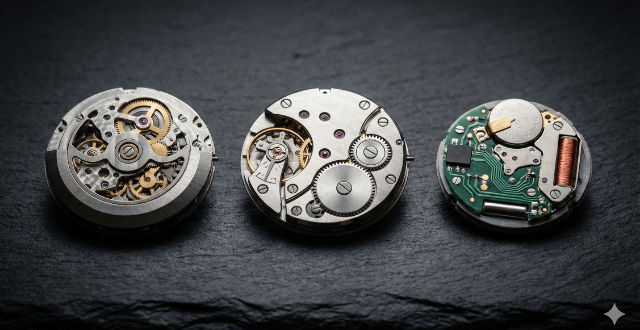
Every mechanical watch contains an engine called a movement, or calibre. This mechanism powers the watch, drives the hands, and determines how accurately your timepiece keeps time. Understanding movement types helps you choose a watch that matches how you actually live.
Three movement types dominate modern watchmaking: automatic (self-winding), manual wind (hand-wound), and quartz (battery-powered). Each works differently, costs differently to maintain, and suits different owners.The Three Movement Types
Before comparing specifications, understanding how each movement type functions clarifies why their characteristics differ so dramatically.
Automatic (Self-Winding) Movements
Automatic movements use a weighted rotor attached to the movement's back. When you move your wrist, gravity causes this rotor to spin. A series of gears transfers this rotational energy to wind the mainspring, the coiled steel spring that stores power.
The mainspring gradually releases its stored energy through a gear train to the escapement, which regulates the release in precise increments. This controlled release drives the hands and keeps time.
Key characteristics of automatic movements:
| Aspect | Details |
|---|---|
| Power source | Mainspring wound by rotor motion |
| Winding method | Movement of wearer's wrist |
| Typical power reserve | 38-72 hours |
| Can be hand-wound? | Most modern automatics, yes |
| Battery required | No |
When worn daily, an automatic watch maintains its power reserve without intervention. If left unworn for several days, the mainspring unwinds and the watch stops. You then need to wind it manually (if the movement allows) and reset the time.
Manual Wind (Hand-Wound) Movements
Manual wind movements are the oldest mechanical watch technology, predating automatics by centuries. They work identically to automatics in how they keep time, but lack the rotor mechanism. Instead, you wind the mainspring directly by turning the crown.
Each morning, you wind the crown clockwise until you feel resistance, indicating the mainspring is fully wound. This ritual takes 20-40 turns depending on the movement. The mainspring then releases its energy throughout the day, powering the watch until it needs winding again.
Key characteristics of manual movements:
| Aspect | Details |
|---|---|
| Power source | Mainspring wound by crown |
| Winding method | Manual crown rotation daily |
| Typical power reserve | 40-48 hours (some exceed 70 hours) |
| Winding frequency | Once daily for optimal performance |
| Battery required | No |
Manual movements appeal to enthusiasts who enjoy the daily interaction with their watch. The absence of a rotor also enables thinner cases and unobstructed views of the movement through display casebacks.
Quartz Movements
Quartz movements represent a fundamentally different technology. A battery sends an electrical current through a tiny quartz crystal, causing it to vibrate at a precise frequency: 32,768 times per second. An integrated circuit counts these vibrations and sends a pulse to move the second hand forward once per second (or drives a digital display).
This consistent, high-frequency vibration is why quartz watches dramatically outperform mechanical watches in accuracy.
Key characteristics of quartz movements:
| Aspect | Details |
|---|---|
| Power source | Battery |
| Vibration frequency | 32,768 Hz (vs 3-4 Hz for mechanical) |
| Typical battery life | 2-5 years |
| Winding required | No |
| Accuracy | Far superior to mechanical |
Quartz movements contain far fewer parts than mechanical movements, making them cheaper to produce and less prone to failure. The tradeoff is the need for periodic battery replacement and, for many collectors, a perceived lack of "soul" compared to mechanical watches.
Accuracy Comparison
Accuracy represents the most significant functional difference between movement types. The numbers reveal just how vast this gap truly is.
Mechanical Watch Accuracy
Mechanical movements, whether automatic or manual, operate through physical components subject to gravity, temperature, magnetism, and wear. Even premium movements cannot match quartz precision.
| Accuracy Standard | Specification | Notes |
|---|---|---|
| Entry-level automatic | ±20-40 seconds/day | Budget movements (Miyota 8215, etc.) |
| Mid-range automatic | ±10-15 seconds/day | Quality movements (ETA 2824-2, Sellita) |
| High-grade automatic | ±5-10 seconds/day | Premium movements, well-regulated |
| COSC Chronometer | -4/+6 seconds/day | Official Swiss certification |
| Rolex Superlative Chronometer | -2/+2 seconds/day | In-house Rolex standard |
| METAS Master Chronometer | 0/+5 seconds/day | Omega/Tudor certification |
| Exceptional (Zenith Defy Lab) | ±0.3 seconds/day | Cutting-edge technology |
Quartz Watch Accuracy
Quartz movements operate in an entirely different accuracy league.
| Accuracy Standard | Specification | Notes |
|---|---|---|
| Basic quartz | ±15 seconds/month | Standard consumer watches |
| Mid-range quartz | ±10 seconds/month | Better quality movements |
| COSC-certified quartz | ±0.07 seconds/day | Official chronometer standard |
| High Accuracy Quartz (HAQ) | ±10 seconds/year | Thermo-compensated movements |
| Grand Seiko 9F | ±10 seconds/year | Hand-assembled HAQ |
| Longines VHP | ±5 seconds/year | Very High Precision |
| Citizen Caliber 0100 | ±1 second/year | Most accurate production quartz |
Direct Comparison
| Movement Type | Daily Accuracy | Monthly Drift | Annual Drift |
|---|---|---|---|
| Entry-level automatic | ±20-40 sec | ±10-20 min | ±2-4 hours |
| COSC chronometer | -4/+6 sec | ±2.5 min | ±30 min |
| Rolex Superlative | ±2 sec | ±1 min | ±12 min |
| Basic quartz | ±0.5 sec | ±15 sec | ±3 min |
| HAQ (Grand Seiko 9F) | ±0.03 sec | ±0.8 sec | ±10 sec |
The accuracy gap is staggering. The most accurate production mechanical watch (Zenith Defy Lab at ±0.3 seconds/day) is still less accurate than a basic S$50 quartz watch. The most accurate quartz movement (Citizen Caliber 0100 at ±1 second/year) is approximately 100 times more accurate than a COSC-certified mechanical chronometer.
Why Choose Mechanical Despite Lower Accuracy?
Given quartz superiority in accuracy, cost, and maintenance, why do collectors pay premium prices for inferior timekeeping? The answer lies beyond pure function.
The Case for Mechanical Watches
| Factor | Why It Matters |
|---|---|
| Craftsmanship appreciation | Hundreds of hand-assembled components working in coordination |
| No batteries | Self-sufficient; never needs battery replacement |
| Longevity | Can last generations with proper service |
| Tradition | Centuries of horological heritage |
| Tactile engagement | Physical winding creates connection with timepiece |
| Investment potential | Certain mechanical watches appreciate in value |
| Status signalling | Mechanical watches carry prestige quartz cannot match |
| Movement visibility | Display casebacks reveal mechanical artistry |
The Case for Quartz Watches
| Factor | Why It Matters |
|---|---|
| Superior accuracy | Vastly better timekeeping than any mechanical |
| Lower maintenance | Battery change vs full mechanical service |
| Lower cost | Both purchase price and lifetime ownership |
| Reliability | Fewer components means fewer failure points |
| Convenience | No winding, no watch winders needed |
| Durability | Less sensitive to shocks and position |
| Grab-and-go | Always running, always accurate |
Neither choice is objectively "better." They serve different priorities.
Automatic vs Manual: The Mechanical Choice
If you've decided on a mechanical watch, you face a secondary choice: automatic or manual wind?
Comparative Specifications
| Specification | Automatic | Manual Wind |
|---|---|---|
| Case thickness | Slightly thicker (rotor adds ~1-2mm) | Thinner possible |
| Weight | Heavier (weighted rotor) | Lighter |
| Winding requirement | Wear it or use winder | Wind daily |
| Movement visibility | Rotor obscures portion | Full movement view |
| Maintenance complexity | More parts to service | Simpler mechanism |
| Power reserve consistency | More consistent (constantly topped up) | Varies with mainspring state |
| Crown wear | Less (rotor does most winding) | More (daily winding) |
| Accuracy consistency | Slightly better (consistent power) | Slightly variable |
Who Should Choose Automatic
Automatic movements suit collectors who:
- Wear one watch daily as their primary timepiece
- Prefer convenience over ritual
- Rotate through a small collection (2-5 watches)
- Use watch winders for storage
- Don't want to remember daily winding
Who Should Choose Manual Wind
Manual wind movements suit collectors who:
- Enjoy the daily winding ritual
- Appreciate thinner case profiles
- Want unobstructed movement views through display backs
- Own the Omega Speedmaster Moonwatch (the iconic manual-wound chronograph)
- Prefer simpler mechanics with fewer potential failure points
- View winding as connection with their timepiece
Automatic vs Manual: Accuracy Difference
Contrary to some claims, there is no inherent accuracy advantage to either winding type. Both automatic and manual movements can achieve identical accuracy specifications. The movement's quality, regulation, and condition matter far more than whether it winds automatically or manually.
Theoretical consideration: An automatic movement maintains more consistent mainspring tension throughout the day (the rotor constantly tops up power). A manual watch's mainspring gradually unwinds, and some movements run slightly faster when fully wound, slightly slower when nearly depleted. In practice, this difference is negligible for quality movements.
Power Reserve Explained
Power reserve indicates how long a fully wound watch will run before stopping.
| Movement Type | Typical Power Reserve | Extended Power Reserve |
|---|---|---|
| Entry-level automatic | 38-42 hours | - |
| Mid-range automatic | 42-48 hours | - |
| Modern premium automatic | 60-72 hours | Some exceed 80 hours |
| Manual wind (vintage) | 36-42 hours | - |
| Manual wind (modern) | 42-50 hours | Some exceed 70 hours |
| Quartz | 2-5 years (battery life) | Solar: 6+ months on full charge |
For automatic watches worn daily, power reserve determines how long the watch keeps running if you take it off Friday evening and don't wear it until Monday morning. A 38-hour power reserve might not make it; a 70-hour reserve will.
For manual wind watches, longer power reserve means you could theoretically wind every other day instead of daily, though daily winding is still recommended for consistency.
For quartz watches, power reserve isn't really a concern; the battery lasts years, and many quartz watches include end-of-life indicators (the second hand jumps in 4-second intervals instead of 1-second) to warn you before the battery dies completely.
Maintenance Requirements
Long-term ownership costs differ dramatically between movement types.
Automatic Watch Maintenance
| Service Type | Interval | Typical Cost (S$) |
|---|---|---|
| Full service | Every 5-10 years | S$300-1,500+ |
| Water resistance test | Every 2-3 years (if diving) | S$50-100 |
| Crystal replacement (if damaged) | As needed | S$100-300 |
| Bracelet refinishing | As desired | S$150-300 |
Full service involves complete disassembly, cleaning, inspection, part replacement (gaskets, worn components), lubrication, reassembly, regulation, and testing. The cost depends heavily on brand: a Seiko automatic might cost S$200-400 to service; an Omega costs S$700-1,000; a Rolex costs S$800-1,500.
Manual Wind Maintenance
| Service Type | Interval | Typical Cost (S$) |
|---|---|---|
| Full service | Every 3-5 years | S$250-1,200+ |
| Crown/stem replacement | As needed (crown wears faster) | S$50-150 |
| Water resistance test | Every 2-3 years (if diving) | S$50-100 |
Manual movements have fewer parts than automatics (no rotor, reverser wheels, or automatic winding mechanism), which can mean slightly lower service costs. However, daily crown winding causes more wear on crown seals and stems, potentially requiring more frequent crown-related repairs.
Quartz Watch Maintenance
| Service Type | Interval | Typical Cost (S$) |
|---|---|---|
| Battery replacement | Every 2-5 years | S$15-60 |
| Battery + gasket + pressure test | Every 2-5 years | S$40-100 |
| Full quartz service | Every 7-10 years (optional) | S$150-400 |
| Circuit replacement (if failed) | As needed | S$100-300 |
Most quartz watches need only battery replacement throughout their lifetime. High-end quartz movements (like Grand Seiko 9F) are designed with jeweled gear trains and hand assembly; these do benefit from periodic full service, but the cost remains lower than equivalent mechanical service.
10-Year Ownership Cost Comparison
| Movement Type | Service Events (10 years) | Estimated Total Cost (S$) |
|---|---|---|
| Entry-level automatic | 1-2 full services | S$400-800 |
| Mid-range automatic | 1-2 full services | S$600-1,200 |
| Luxury automatic (Rolex, Omega) | 1 full service | S$800-1,500 |
| Manual wind (mid-range) | 2 full services | S$500-1,000 |
| Basic quartz | 3-4 battery changes | S$60-150 |
| HAQ quartz | 2-3 battery changes | S$60-120 |
Over a decade, quartz ownership costs are roughly 10-20% of equivalent mechanical watch ownership costs.
Environmental Considerations
Movement types respond differently to environmental factors.
Temperature Effects
| Movement Type | Temperature Sensitivity |
|---|---|
| Mechanical | High. Lubricants thicken in cold, thin in heat. Metal components expand/contract. Accuracy affected at extremes. |
| Standard quartz | Moderate. Crystal frequency varies with temperature (~0.034 sec/day per °C deviation from 25°C). |
| HAQ quartz | Low. Thermo-compensation actively adjusts for temperature changes. |
Magnetic Field Effects
| Movement Type | Magnetic Vulnerability |
|---|---|
| Standard mechanical | High. Steel components magnetise, affecting accuracy dramatically. |
| Antimagnetic mechanical | Moderate. Silicon/special alloy components resist common field strengths. |
| Master Chronometer (Omega) | Low. Rated to 15,000 gauss. |
| Quartz | Very low. Quartz crystal unaffected by magnetic fields. |
Shock Resistance
| Movement Type | Shock Vulnerability |
|---|---|
| Manual wind | Moderate. No rotor, but delicate balance and escapement. |
| Automatic | Moderate. Rotor adds mass; some have shock protection. |
| Quartz | Low. Fewer moving parts, simpler mechanism. |
For rough use, active sports, or environments with strong magnetic fields, quartz offers practical advantages.
Price Range by Movement Type
Movement type strongly influences price, though overlap exists at various tiers.
Quartz Watches
| Price Tier | Examples | What to Expect |
|---|---|---|
| Budget (S$50-200) | Casio, Timex, Seiko | Reliable timekeeping, basic finishing |
| Mid-range (S$200-1,000) | Tissot, Citizen Eco-Drive, Bulova Precisionist | Better materials, some HAQ options |
| Premium (S$1,000-5,000) | Grand Seiko 9F, Longines VHP, Breitling SuperQuartz | HAQ accuracy, luxury finishing |
| Luxury (S$5,000+) | Omega Aqua Terra Quartz, Cartier Tank Quartz | Brand prestige, precious materials |
Automatic Watches
| Price Tier | Examples | What to Expect |
|---|---|---|
| Entry (S$200-500) | Seiko Presage, Orient, Tissot PRX | Reliable movements, basic finishing |
| Mid-range (S$500-2,000) | Hamilton, Longines, Mido | Swiss movements, better finishing |
| Premium (S$2,000-8,000) | Omega, Tudor, TAG Heuer | COSC certification, in-house movements |
| Luxury (S$8,000+) | Rolex, Grand Seiko, IWC | Top-tier movements, exceptional finishing |
Manual Wind Watches
Manual wind options are less common in modern production, concentrated at premium and luxury tiers.
| Price Tier | Examples | What to Expect |
|---|---|---|
| Entry (S$300-800) | Hamilton Khaki Mechanical, Stowa | Classic designs, reliable movements |
| Premium (S$3,000-10,000) | Omega Speedmaster Moonwatch, Nomos | Iconic references, excellent finishing |
| Luxury (S$10,000+) | Patek Philippe Calatrava, A. Lange & Söhne | High horology, exceptional craftsmanship |
Choosing Your Movement Type
Use this decision framework based on your priorities.
Choose Automatic If:
| Priority | Why Automatic Fits |
|---|---|
| Convenience | Self-winds with wear; minimal intervention |
| Primary daily watch | Stays wound with regular use |
| Collection of 2-5 watches | Manageable with occasional winding or watch winder |
| Appreciation of mechanics | Visible rotor, complex engineering |
| Long-term ownership | Can last generations with service |
| Status and prestige | Mechanical watches carry social value |
Choose Manual Wind If:
| Priority | Why Manual Fits |
|---|---|
| Daily ritual | Winding creates connection with watch |
| Slimmer profile | No rotor allows thinner cases |
| Movement appreciation | Full view through display caseback |
| Iconic references | Speedmaster Moonwatch, vintage pieces |
| Simpler mechanics | Fewer parts to potentially fail |
| Purist philosophy | Oldest form of mechanical timekeeping |
Choose Quartz If:
| Priority | Why Quartz Fits |
|---|---|
| Accuracy | Superior timekeeping by orders of magnitude |
| Low maintenance | Battery replacement vs full service |
| Reliability | Fewer moving parts, simpler mechanism |
| Value | More watch for less money |
| Grab-and-go | Always running, always accurate |
| Large collection | Impractical to keep many mechanicals running |
| Tool watch use | Better shock and magnetic resistance |
Decision Matrix
| Your Situation | Recommended Movement |
|---|---|
| One watch, worn daily | Automatic |
| Collection of 10+ watches | Quartz or selective automatics |
| Accuracy-critical profession | Quartz or HAQ |
| Watch as family heirloom | Mechanical (automatic or manual) |
| Active lifestyle, rough use | Quartz |
| Appreciation of craftsmanship | Mechanical (automatic or manual) |
| Budget-conscious | Quartz |
| Status signalling priority | Mechanical (automatic or manual) |
| Slim dress watch | Manual wind |
Hybrid and Alternative Technologies
Beyond the three main categories, several hybrid technologies exist.
Meca-Quartz
Meca-quartz movements combine quartz regulation with a mechanical chronograph module. The timekeeping remains quartz-accurate, but the chronograph seconds hand sweeps smoothly rather than ticking, and pusher feel resembles mechanical chronographs. Examples include Seiko VK series movements used in many affordable chronographs.
Spring Drive
Grand Seiko's Spring Drive uses a mainspring (like mechanical watches) but regulates timekeeping with an electronic regulator instead of a traditional escapement. The result: ±1 second per day accuracy (far better than mechanical, approaching quartz) with a sweeping seconds hand and no battery requirement. It's charged by the mainspring like any mechanical watch.
| Spring Drive Specifications | |
|---|---|
| Accuracy | ±1 second/day (±15 seconds/month) |
| Power source | Mainspring |
| Regulation | Electronic (quartz-controlled) |
| Battery | None required |
| Second hand | Continuous sweep |
| Service | Similar to mechanical |
Kinetic/Auto-Quartz
Seiko's Kinetic technology uses wrist motion (like automatic) to generate electricity stored in a capacitor, powering a quartz movement. No battery replacement needed. Citizen's Eco-Drive similarly uses light (solar) to charge a capacitor powering quartz timekeeping.
| Technology | Power Source | Accuracy | Battery |
|---|---|---|---|
| Kinetic (Seiko) | Wrist motion | Quartz-level | Capacitor (no replacement) |
| Eco-Drive (Citizen) | Light (solar) | Quartz-level | Capacitor (no replacement) |
| Spring Drive (Grand Seiko) | Mainspring | ±1 sec/day | None |
Common Misconceptions
Several myths persist about watch movements.
"Automatic watches are more accurate than manual"
Reality: There is no inherent accuracy difference. Both use identical timekeeping mechanisms (balance wheel, escapement, gear train). Build quality and regulation determine accuracy, not winding method."Quartz watches are inferior"
Reality: Quartz watches are functionally superior in accuracy, reliability, and maintenance costs. "Inferior" only applies if you value mechanical craftsmanship, tradition, or status signalling above practical performance."Mechanical watches last forever"
Reality: Mechanical watches require regular service (every 5-10 years) to remain accurate and functional. Without service, lubricants degrade, parts wear, and the watch eventually fails. With proper service, yes, they can last generations."You must use a watch winder for automatic watches"
Reality: Watch winders are convenient but unnecessary for most collectors. Modern automatics with 40+ hour power reserves can be set and wound when you want to wear them. Winders are most valuable for complicated watches (perpetual calendars, moonphases) that are tedious to reset."HAQ quartz is as prestigious as mechanical"
Reality: Despite superior specifications, HAQ quartz hasn't achieved the prestige of premium mechanical watches. Grand Seiko 9F models, for example, cost S$3,000-5,000 and offer ±10 seconds/year accuracy, yet carry less status than mechanicals at the same price. Market perception values mechanical heritage over functional performance.Singapore Considerations
For collectors in Singapore and Malaysia, several local factors apply.
Climate Effects
Singapore's tropical climate (high heat and humidity year-round) affects watch performance.
| Movement Type | Climate Consideration |
|---|---|
| Mechanical | Lubricants may thin faster in constant heat; service intervals might need shortening |
| Quartz | Less affected; stable performance regardless of climate |
| All types | High humidity increases importance of proper water resistance and gasket maintenance |
Service Options
Singapore has excellent watch service infrastructure.
| Service Type | Options |
|---|---|
| Authorised service centres | Available for major brands (Rolex, Omega, Grand Seiko, etc.) at ION Orchard, Marina Bay Sands, Tong Building |
| Independent watchmakers | Numerous qualified options throughout Singapore |
| Quick battery service | Available at most shopping malls |
Purchase Considerations
| Factor | Notes |
|---|---|
| Humidity | Ensure water resistance is tested regularly |
| Air conditioning cycling | Rapid temperature changes (outdoor to aircon) can affect accuracy |
| Active lifestyle | Heat and perspiration increase wear on straps and gaskets |
FAQ
How accurate should a mechanical watch be?
A quality mechanical watch should run within ±10 seconds per day. COSC-certified chronometers are guaranteed to -4/+6 seconds per day. Premium standards like Rolex Superlative Chronometer require -2/+2 seconds per day. If your mechanical watch gains or loses more than 20 seconds daily, it may need service.
How often should I wind a manual watch?
Wind your manual watch once daily at approximately the same time for best accuracy. Wind until you feel resistance, indicating the mainspring is fully wound. Do not force past this point to avoid damaging the mainspring.
Can you overwind an automatic watch?
No. Automatic watches include a slipping clutch mechanism that prevents overwinding. Once the mainspring is fully wound, the rotor continues to spin but doesn't add more tension. You cannot damage an automatic by overwearing it.
How long do quartz watch batteries last?
Standard quartz batteries last 2-5 years depending on the movement and complications. Chronograph quartz movements drain batteries faster than time-only movements. Many quartz watches indicate low battery through a 4-second interval second hand movement instead of the normal 1-second tick.
Do I need a watch winder for automatic watches?
Watch winders are convenient but not necessary for most watches. If you rotate between several automatics, you can simply wind them manually and set the time when you want to wear them. Winders are most valuable for perpetual calendars and other complicated watches that are tedious to reset after stopping.
Is quartz or automatic better for a first watch?
For a first quality watch, both are excellent choices serving different priorities. Quartz offers superior accuracy, lower maintenance, and lower cost. Automatic offers mechanical fascination, no batteries, and potential appreciation. Consider what matters more to you: practical performance or horological appreciation.
Can mechanical watches get magnetised?
Yes. Mechanical watches contain steel components that can become magnetised by exposure to strong magnetic fields (speakers, laptops, MRI machines, etc.). Magnetisation causes the watch to run fast, sometimes by minutes per day. Demagnetisation is a quick, inexpensive fix (S$20-50) that doesn't require full service.
How does temperature affect watch accuracy?
Mechanical watches run faster in cold (metal contracts, balance swings faster) and slower in heat (metal expands). Standard quartz crystals also drift with temperature, but HAQ movements compensate automatically. For extreme temperature environments, HAQ quartz is most reliable.
Are expensive quartz movements worth it?
High Accuracy Quartz movements like Grand Seiko 9F (±10 seconds/year) or Citizen Caliber 0100 (±1 second/year) offer dramatically better accuracy than standard quartz (±15 seconds/month). Whether this matters depends on your priorities. For most users, standard quartz is "accurate enough." HAQ appeals to those who value precision as its own reward.
MINT Conclusion
Understanding movement types helps you choose watches that match how you actually live. Automatic movements offer convenience and mechanical fascination. Manual movements provide daily ritual and classic aesthetics. Quartz movements deliver superior accuracy and lower ownership costs.
Whichever technology you prefer, a quality watch represents significant value, often thousands of dollars for models you'll wear for years or decades. Standard home insurance typically provides inadequate coverage for luxury timepieces, leaving your investment exposed to theft, loss, or accidental damage.
MINT provides specialist watch insurance designed specifically for Singapore collectors, protecting your automatic, manual, or quartz timepieces against risks no manufacturer warranty covers.
For more information, see watch insurance Singapore or how servicing affects your watch's value.Protect Your Watch Collection
Own a luxury timepiece? Make sure it's properly protected. MINT provides specialist watch insurance in Singapore covering theft, loss, and accidental damage worldwide. From $8/month for comprehensive coverage trusted by Singapore collectors.
- Watch Insurance Singapore – Complete coverage guide
- How to Insure Your Rolex – Step-by-step guide
- Dealer Insurance – For watch businesses
Read other articles