Tudor vs Rolex: Are They Really That Different?

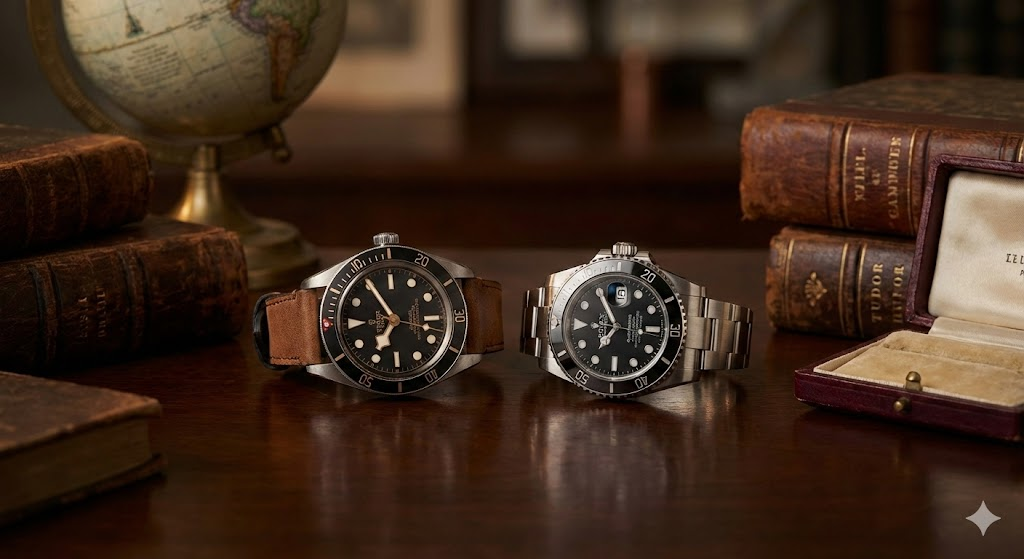
Tudor and Rolex share the same founder, the same foundation ownership, and decades of shared DNA. Yet one costs three times more than the other. The question collectors constantly ask: is the Rolex genuinely three times better, or is Tudor the smarter buy?
The answer depends entirely on what "better" means to you, and understanding the real differences between these brands requires looking beyond marketing narratives.This guide examines:
- The actual ownership and manufacturing relationship
- Movement technology and what differs between the brands
- Build quality, materials, and finishing at each price point
- Value retention and total cost of ownership
- Which buyers should choose each brand
The Ownership Reality
First, let's clarify the relationship that confuses many collectors.
| Question | Answer |
|---|---|
| Does Rolex own Tudor? | No. Both are owned by the Hans Wilsdorf Foundation |
| Are they the same company? | No. They operate as separate entities with independent management |
| Do they share facilities? | Partially. Headquarters in Geneva are shared, but manufacturing is separate |
| Do they share movements? | No. Tudor movements are developed and produced by Kenissi |
| Do they share parts? | Not anymore. Modern Tudors use entirely Tudor-specific components |
Hans Wilsdorf founded Rolex in 1905 and registered the Tudor trademark in 1926. His vision was straightforward: create a more accessible brand that maintained Rolex quality standards at lower price points.
For decades, Tudor achieved this by using Rolex cases, bracelets, and crowns combined with third-party movements. Vintage Tudor Submariners from the 1950s through 1990s were essentially Rolex cases with ETA movements inside.
That relationship ended definitively in 2015.The Modern Split: Two Separate Companies
The Tudor you buy today bears almost no manufacturing relationship to Rolex beyond shared ownership.
| Era | Tudor's Relationship to Rolex |
|---|---|
| 1926-1969 | Used Rolex cases, crowns, and bracelets with third-party movements |
| 1969-2015 | Gradually developed independent identity while still sharing some components |
| 2015-2021 | Launched in-house movements via Kenissi; still assembled at Rolex Geneva HQ |
| 2021-present | Fully independent manufacturing at Tudor's Le Locle facility |
Since 2021, Tudor watches are manufactured, assembled, and tested at Tudor's purpose-built facility in Le Locle, Switzerland. This 10,600 square metre factory handles everything from movement assembly to final quality control.
The facility is physically connected to Kenissi, the movement manufacturer that Tudor founded in 2016 and majority owns (with Chanel holding a minority stake). Kenissi now supplies movements to Tudor, Breitling, Chanel, TAG Heuer, Norqain, and others.
The key point: Tudor is no longer manufactured by Rolex. They share heritage and ownership structure, but operate as completely separate watchmaking entities.Movement Comparison: The Technical Reality
This is where the brands diverge most significantly in approach.
Tudor Movements
Tudor's current movements are manufactured by Kenissi to Tudor's specifications.
| Movement | Used In | Power Reserve | Certification | Magnetic Resistance |
|---|---|---|---|---|
| MT5402 | Black Bay 58, Ranger | 70 hours | COSC | Silicon hairspring |
| MT5400 | Black Bay 58 Bronze, 925, 18K | 70 hours | COSC | Silicon hairspring |
| MT5602 | Black Bay 41 (pre-2023) | 70 hours | COSC | Silicon hairspring |
| MT5602-U | Black Bay 41 (2023+), others | 70 hours | COSC + METAS | 15,000 gauss |
| MT5652 | Black Bay GMT | 70 hours | COSC | Silicon hairspring |
- Frequency: 28,800 vph (4Hz)
- Silicon hairspring (antimagnetic)
- Free-sprung balance with adjustable weights
- Bidirectional winding
- Full balance bridge design
Rolex Movements
Rolex manufactures all movements entirely in-house at their Bienne facility.
| Movement | Used In | Power Reserve | Certification | Magnetic Resistance |
|---|---|---|---|---|
| 3230 | Submariner (no-date), Explorer | 70 hours | COSC + Superlative | ~1,000 gauss (Parachrom) |
| 3235 | Submariner Date, GMT-Master II, Datejust | 70 hours | COSC + Superlative | ~1,000 gauss (Parachrom) |
| 3186 | Older GMT-Master II | 48 hours | COSC + Superlative | ~1,000 gauss (Parachrom) |
| 3131 | Milgauss | 48 hours | COSC + Superlative | 1,000 gauss |
- Frequency: 28,800 vph (4Hz)
- Parachrom hairspring (paramagnetic, not fully antimagnetic)
- Chronergy escapement (15% more efficient than standard)
- Bidirectional winding with optimised rotor
- Full balance bridge design
Movement Comparison: What Actually Differs
| Specification | Tudor (MT5402/MT5602-U) | Rolex (3230/3235) |
|---|---|---|
| Power reserve | 70 hours | 70 hours |
| Frequency | 28,800 vph | 28,800 vph |
| Hairspring | Silicon | Parachrom |
| Magnetic resistance | 15,000 gauss (METAS models) | ~1,000 gauss |
| Escapement | Standard Swiss lever | Chronergy (proprietary) |
| Balance bridge | Full | Full |
| Certification | COSC (or COSC + METAS) | COSC + Superlative Chronometer |
| Accuracy standard | -2/+4 sec/day (Tudor spec) | -2/+2 sec/day (Rolex spec) |
Tudor's METAS-certified movements actually exceed Rolex specifications for magnetic resistance: 15,000 gauss versus approximately 1,000 gauss. If you work around MRI machines or strong magnetic fields, Tudor's newer movements offer better protection.
Rolex's Superlative Chronometer standard (-2/+2 seconds per day) is tighter than COSC's -4/+6, but Tudor voluntarily holds their movements to -2/+4. In practice, both keep time accurately enough that you'd never notice the difference in daily wear.
The Chronergy escapement is a genuine Rolex innovation that improves efficiency, but the practical benefit is already captured in the 70-hour power reserve, which both brands now achieve.
Neither movement is objectively "better." They're different engineering solutions achieving similar results.Case and Build Quality
This is where Rolex's price premium becomes more tangible.
Materials
| Component | Tudor | Rolex |
|---|---|---|
| Case steel | 316L stainless steel | 904L Oystersteel |
| Bezel insert | Aluminium (most models) or ceramic | Cerachrom ceramic |
| Crystal | Sapphire (domed on BB58) | Sapphire with Cyclops |
| Caseback | Solid steel (most) or exhibition | Solid steel |
| Crown | Steel with Tudor rose | Steel with Rolex crown, Triplock system |
Rolex's 904L steel (which they brand as "Oystersteel") is more corrosion-resistant than standard 316L and takes a higher polish. The difference is subtle but real: 904L maintains its finish longer in salt water and humid environments. It's also harder to machine, contributing to higher production costs.
Tudor's 316L steel is the same grade used by Omega, IWC, and virtually every other luxury brand. It's excellent material that will serve you well for decades.
Finishing Quality
| Aspect | Tudor | Rolex |
|---|---|---|
| Brushed surfaces | Good consistency | Exceptional consistency |
| Polished surfaces | Good | Mirror-perfect |
| Transitions between finishes | Clean | Laser-sharp |
| Bracelet link tolerances | Slight play acceptable | Minimal play |
| Crown action | Smooth, reliable | Exceptionally smooth with distinctive sealed feel |
| Bezel action | Excellent (60 clicks) | Excellent (120 clicks) |
Examine a Rolex Submariner under a loupe and you'll struggle to find any finishing flaw. The brushed surfaces are uniform to an almost obsessive degree. Transitions between brushed and polished areas are knife-edge precise.
Examine a Tudor Black Bay under the same loupe and you'll find excellent finishing that occasionally shows minor inconsistencies: a brushing line slightly off-angle, a polished edge marginally less crisp. These imperfections are invisible to the naked eye and irrelevant to the watch's function.
Is Rolex finishing three times better than Tudor? No. Is it noticeably better under magnification? Yes. Does it matter in daily wear? Not really.Model Comparisons
Tudor Black Bay 58 vs Rolex Submariner
The most direct comparison in both brands' lineups.
| Specification | Tudor Black Bay 58 (79030N) | Rolex Submariner (124060) |
|---|---|---|
| Case diameter | 39mm | 41mm |
| Thickness | 11.9mm | 11.4mm |
| Lug-to-lug | 47.5mm | 48mm |
| Water resistance | 200m | 300m |
| Bezel | Aluminium, 60 clicks | Cerachrom ceramic, 120 clicks |
| Movement | MT5402 | 3230 |
| Power reserve | 70 hours | 70 hours |
| Crystal | Domed sapphire | Flat sapphire with Cyclops |
| Retail price | S$6,000 | S$12,350 |
| Secondary market | S$3,500-4,000 | S$13,500-15,000 |
The Black Bay 58 is intentionally vintage-inspired. The domed crystal, gilt dial accents, and 39mm case reference Tudor dive watches from the 1950s. It's designed to look like it has history.
The Submariner is designed to look timeless and contemporary. The flat crystal, sharper case lines, and 41mm size reflect modern tool-watch aesthetics.
Tudor Ranger vs Rolex Explorer
| Specification | Tudor Ranger (79950) | Rolex Explorer (124270) |
|---|---|---|
| Case diameter | 39mm | 36mm |
| Thickness | 12mm | 11.5mm |
| Water resistance | 100m | 100m |
| Bezel | Fixed, polished | Fixed, polished |
| Movement | MT5402 | 3230 |
| Power reserve | 70 hours | 70 hours |
| Dial | Matte black, Arabic numerals | Black with 3-6-9 Arabic, luminous markers |
| Retail price | S$4,600 | S$9,650 |
| Secondary market | S$2,800-3,200 | S$9,000-10,500 |
The Ranger emphasises utilitarian tool-watch heritage with a fully matte, brushed case and no-frills dial. It's deliberately understated.
The Explorer balances sportiness with subtle elegance through polished accents and the iconic 3-6-9 dial layout. The 36mm size makes it exceptionally versatile.
Tudor Black Bay 41 vs Rolex Submariner
A closer size match than the BB58 comparison.
| Specification | Tudor Black Bay 41 (7941A1A0RU) | Rolex Submariner Date (126610LN) |
|---|---|---|
| Case diameter | 41mm | 41mm |
| Thickness | 13.6mm | 12.3mm |
| Water resistance | 200m | 300m |
| Bezel | Aluminium, 60 clicks | Cerachrom ceramic, 120 clicks |
| Movement | MT5602-U (METAS certified) | 3235 |
| Power reserve | 70 hours | 70 hours |
| Date display | No | Yes, with Cyclops |
| Retail price | S$6,700 (bracelet) | S$13,500 |
| Secondary market | S$4,200-4,500 | S$14,000-17,000 |
The refreshed Black Bay 41 from 2023 represents Tudor's most technically advanced offering: METAS-certified movement with 15,000-gauss magnetic resistance, slimmer case profile, and new T-fit clasp with on-the-fly adjustment.
Pricing and Value Retention
This is where the brands diverge most dramatically.
Current Pricing (January 2026)
| Model | Retail (S$) | Secondary Market (S$) | Premium/Discount |
|---|---|---|---|
| Tudor Black Bay 58 | 6,000 | 3,500-4,000 | -33% to -42% |
| Tudor Black Bay 41 (METAS) | 6,700 | 4,200-4,500 | -33% to -37% |
| Tudor Ranger | 4,600 | 2,800-3,200 | -30% to -39% |
| Tudor Pelagos 39 | 5,750 | 4,000-4,500 | -22% to -30% |
| Rolex Submariner (no-date) | 12,350 | 13,500-15,000 | +9% to +21% |
| Rolex Submariner Date | 13,500 | 14,000-17,000 | +4% to +26% |
| Rolex Explorer | 9,650 | 9,000-10,500 | -7% to +9% |
| Rolex GMT-Master II | 14,200 | 18,000-22,000 | +27% to +55% |
Value Retention Over Time
| Metric | Tudor | Rolex (steel sports) |
|---|---|---|
| Immediate depreciation (buy new) | 30-40% | 0% or appreciation |
| 5-year retention | 50-60% of retail | 90-120% of retail |
| Liquidity (time to sell) | 3-6 weeks | Days |
| Market volatility | Higher | Lower |
Buying a new Tudor means accepting significant immediate depreciation. A S$6,000 Black Bay 58 becomes worth S$3,500-4,000 the moment you leave the boutique.
Buying a new Rolex sports model at retail (if you can get one) means owning an asset worth more than you paid. Even grey market purchases at premium prices tend to hold value.
However, this creates opportunity for Tudor buyers. Purchasing pre-owned at S$3,500-4,000 means buying at the watch's true market value with minimal further depreciation risk.
For value-conscious collectors, a pre-owned Tudor delivers exceptional watchmaking at its real price, while Rolex requires either dealer relationships for retail access or significant premiums for immediate availability.Availability and Purchase Experience
Tudor
| Aspect | Reality |
|---|---|
| Boutique availability | Generally in stock |
| Authorised dealer availability | Good |
| Waitlists | Rare, except limited editions |
| Purchase experience | Walk in, try on, buy |
| Allocation games | None |
Tudor watches are available through Tudor boutiques, authorised dealers, and the secondary market. The purchase experience is straightforward: if you want a Black Bay 58, you can probably buy one today.
Rolex
| Aspect | Reality |
|---|---|
| Boutique availability | Waitlists for popular models |
| Authorised dealer availability | Requires purchase history |
| Waitlists | 2-5 years for Submariner, GMT |
| Purchase experience | Relationship-dependent |
| Allocation games | Common |
Acquiring a steel Rolex sports watch at retail requires either existing dealer relationships, significant purchase history, or patience measured in years.
The alternative is grey market purchasing at S$2,000-8,000 premiums above retail, which eliminates waiting but reduces value proposition.
For comparison, see Rolex waiting list times.Total Cost of Ownership
Beyond purchase price, ownership costs differ.
| Cost Category | Tudor | Rolex |
|---|---|---|
| Warranty period | 5 years | 5 years |
| Recommended service interval | 5-7 years | 10 years |
| Authorised service cost | S$500-800 | S$800-1,200 |
| Independent service cost | S$250-450 | S$400-700 |
| Insurance (annual) | S$35-60 (1% of S$3,500-6,000) | S$130-170 (1% of S$13,000-17,000) |
10-Year Ownership Cost Comparison
| Component | Tudor Black Bay 58 (new) | Tudor Black Bay 58 (pre-owned) | Rolex Submariner (retail) |
|---|---|---|---|
| Purchase price | S$6,000 | S$3,700 | S$13,500 |
| Services (2 cycles Tudor, 1 Rolex) | S$1,200 | S$1,200 | S$1,000 |
| Insurance (10 years) | S$400 | S$350 | S$1,500 |
| Resale value | (S$3,200) | (S$2,800) | (S$14,000) |
| Net cost | S$4,400 | S$2,450 | S$2,000 |
However, a pre-owned Tudor at market price offers the lowest total ownership cost while delivering 90% of the experience.
Who Should Buy Tudor
Choose Tudor if:
| Priority | Why Tudor Delivers |
|---|---|
| Immediate availability | Buy what you want, when you want it |
| Budget constraint | Genuine luxury at S$3,500-6,500 |
| METAS certification | Newer Tudor models exceed Rolex magnetic specs |
| Vintage aesthetics | Black Bay 58's domed crystal and gilt accents |
| Value at market price | Pre-owned Tudors offer exceptional value |
| Rejection of allocation culture | Straightforward, respectful transactions |
| 70-hour power reserve | Same as Rolex, achieved years earlier |
Tudor's Weaknesses
| Aspect | Reality |
|---|---|
| Value retention | Significant depreciation when buying new |
| Brand recognition | Lower than Rolex in mainstream perception |
| Resale liquidity | Takes weeks rather than days |
| Finishing | Very good, not exceptional |
| Steel grade | 316L vs Rolex's 904L |
Who Should Buy Rolex
Choose Rolex if:
| Priority | Why Rolex Delivers |
|---|---|
| Value retention | Only mainstream brand that reliably holds value |
| Resale liquidity | Sells in days at predictable prices |
| Brand recognition | Globally recognised status symbol |
| Finishing quality | Exceptional, industry-leading execution |
| Retail access | You have dealer relationships |
| Heritage | The original that defined categories |
Rolex's Weaknesses
| Aspect | Reality |
|---|---|
| Retail availability | Requires relationships or years of waiting |
| Grey market premiums | S$2,000-8,000 above retail |
| Value proposition (at grey prices) | Diminished when paying premium |
| Magnetic resistance | Lower than Tudor METAS models |
| Innovation pace | Conservative, incremental evolution |
Common Misconceptions Addressed
"Tudor is just a cheap Rolex"
False. Tudor was designed as an accessible alternative to Rolex, but "cheap" implies inferior. Modern Tudor uses in-house movements, independent manufacturing, and achieves specifications (like METAS certification) that Rolex doesn't pursue. It's a different product at a different price point, not a cut-rate Rolex.
"Tudor movements are modified Rolex movements"
False. Tudor movements are designed and manufactured by Kenissi, a separate company majority-owned by Tudor. While they share design philosophy (silicon hairspring, full balance bridge), they are not repurposed or modified Rolex calibres. Kenissi also supplies movements to Breitling, Chanel, and TAG Heuer.
"Rolex quality is three times better because the price is three times higher"
False. Rolex finishing is incrementally better than Tudor, but "three times better" doesn't exist in physical reality. The Rolex premium reflects brand positioning, value retention characteristics, and market dynamics, not proportionally superior quality.
"Tudor is a gateway to Rolex"
Sometimes true, sometimes backwards. Many collectors start with Tudor, appreciate the brand on its merits, and never feel the need for Rolex. Others start with Rolex, discover Tudor, and find the value proposition more aligned with their priorities.
"They're made in the same factory"
No longer true. Since 2021, Tudor watches are manufactured at Tudor's Le Locle facility, separate from any Rolex manufacturing. They share headquarters in Geneva for administrative functions, but production is entirely independent.
Pre-Purchase Checklist
For Tudor Purchases
New:- [ ] Confirmed availability at authorised dealer
- [ ] Understood depreciation when buying new
- [ ] Verified 5-year warranty coverage
- [ ] Inspected watch in person
- [ ] Verified authenticity (Tudor counterfeits exist)
- [ ] Confirmed service history
- [ ] Assessed condition against market price
- [ ] Verified complete set (box, papers, warranty card)
For Rolex Purchases
New (retail):- [ ] Established dealer relationship
- [ ] Understood realistic waitlist timeframe
- [ ] Confirmed no purchase history requirements
- [ ] Prepared for allocation uncertainty
- [ ] Verified authenticity through inspection or professional authentication
- [ ] Compared pricing to current market values
- [ ] Understood premium being paid above retail
- [ ] Verified serial numbers and documentation
FAQ
Is Tudor owned by Rolex?
No. Both Tudor and Rolex are owned by the Hans Wilsdorf Foundation, a charitable trust established by Rolex's founder. They operate as separate companies with independent management, manufacturing, and distribution.
Are Tudor movements the same as Rolex movements?
No. Tudor movements are developed and manufactured by Kenissi, a movement maker majority-owned by Tudor. While they share design philosophy with Rolex movements (full balance bridge, antimagnetic materials), they are entirely separate calibres.
Why is Tudor so much cheaper than Rolex?
Tudor uses 316L steel instead of 904L, aluminium bezel inserts instead of ceramic on most models, and outsources movement production to Kenissi rather than manufacturing in-house. These choices reduce production costs while maintaining excellent quality.
Does Tudor hold its value?
Tudor watches depreciate approximately 30-40% when purchased new, then stabilise. Pre-owned Tudor watches at market prices experience minimal further depreciation. Rolex steel sports watches generally hold or exceed retail value.
Which brand is better for everyday wear?
Both are excellent daily wearers. Tudor's Black Bay 58 at 39mm and 11.9mm thick sits comfortably under most cuffs. Rolex's Submariner at 41mm and 12.3mm is equally wearable. Choose based on size preference, aesthetic taste, and budget.
Can Tudor be serviced by Rolex?
No. Tudor watches must be serviced by Tudor authorised service centres or independent watchmakers. Rolex service centres do not service Tudor watches.
Which brand has better warranty coverage?
Both brands offer 5-year warranties on new purchases from authorised dealers. Coverage is comparable.
Is Tudor a good investment?
Tudor watches should not be purchased as investments. They depreciate when bought new and hold value modestly on the secondary market. If value retention matters, Rolex steel sports watches are the better choice. If you want to enjoy a watch without overpaying, pre-owned Tudor offers excellent value.
Will Tudor ever appreciate like Rolex?
Unlikely for current production models. Tudor lacks Rolex's supply constraints and brand prestige that drive appreciation. Certain discontinued or limited Tudor references have appreciated, but this is the exception, not the rule.
Should I buy Tudor if I really want a Rolex but can't get one?
Only if you genuinely appreciate Tudor for what it is. Buying Tudor as a consolation prize leads to dissatisfaction. If you want a Rolex, either wait for retail allocation or pay grey market prices. If you want excellent watchmaking at a reasonable price, buy Tudor because you want Tudor.
MINT Conclusion
Whether you choose Tudor's accessible excellence or Rolex's investment-grade prestige, you're acquiring a timepiece worth protecting properly.
Tudor's S$3,500-6,500 market values still represent significant exposure: theft, loss, or damage means meaningful financial loss that standard home insurance often won't adequately cover. Single-item limits, exclusions for unattended vehicle theft, and depreciated payouts can leave you substantially short.
Rolex's S$13,000-20,000+ values create even greater exposure, particularly when grey market premiums push acquisition costs well above retail. Protecting these values requires coverage that reflects actual replacement cost, not original purchase price.
MINT provides specialist watch insurance designed for luxury timepieces at both price points. Whether your collection features Tudor's value-driven quality or Rolex's appreciating assets, appropriate coverage ensures you can wear and enjoy your watches without worrying about what might go wrong.
For more information, see watch insurance in Singapore and how to insure your Rolex.Protect Your Watch Collection
Own a luxury timepiece? Make sure it's properly protected. MINT provides specialist watch insurance in Singapore covering theft, loss, and accidental damage worldwide. From $8/month for comprehensive coverage trusted by Singapore collectors.
- Watch Insurance Singapore – Complete coverage guide
- How to Insure Your Rolex – Step-by-step guide
- Dealer Insurance – For watch businesses
Read other articles