Rolex vs Omega: Which Brand is Right for You?

This article provides general guidance based on publicly available information, manufacturer specifications, and market data as of January 2026. Prices, specifications, and availability change frequently. Always verify current pricing with authorised dealers. Secondary market prices are approximate and vary based on condition, documentation, and market conditions. This comparison reflects the authors' analysis and should not be considered financial advice.
---
Two names dominate conversations about luxury watches: Rolex and Omega. Both represent Swiss watchmaking excellence. Both have shaped horological history. But they serve different collectors in different ways, and understanding these differences matters before committing thousands of dollars to either brand.
This guide cuts through the marketing to help you decide which brand actually fits your needs.
Brand Overview
Before comparing specifications and prices, understanding what each brand represents helps frame the decision.
Rolex: The Status Symbol
Rolex was founded in 1905 by Hans Wilsdorf in London, relocating to Geneva in 1919. The brand pioneered waterproof cases (Oyster, 1926), self-winding movements (Perpetual, 1931), and date displays (Datejust, 1945). Today, Rolex produces approximately one million watches annually, all COSC chronometer-certified, then regulated in-house to their tighter Superlative Chronometer standard.
Rolex enjoys effectively 100% brand recognition globally. When non-watch people think "luxury watch," they think Rolex. This recognition translates to unmatched resale value and social signalling power, but also to inflated secondary market prices and difficult purchasing experiences at authorised dealers.
Omega: The Technical Pioneer
Louis Brandt founded what would become Omega in 1848 in La Chaux-de-Fonds, making it 57 years older than Rolex. The company adopted the Omega name in 1903 after developing a revolutionary movement calibre. Omega became NASA's official watch for manned spaceflight in 1965, and the Speedmaster remains the only watch qualified for EVA (spacewalk) use.
Omega maintains approximately 70% brand recognition, a remarkable achievement despite being overshadowed by Rolex in popular culture. The brand positions itself on technical innovation, introducing the Co-Axial escapement in 1999 and the METAS Master Chronometer certification in 2015. Omega offers more variety, more complications, and easier purchasing, but lower resale values.
Heritage and Milestones
Both brands have earned their reputations through genuine achievements.
EraRolex MilestoneOmega Milestone1920sFirst waterproof wristwatch (Oyster, 1926)First minute repeater wristwatch (1892)1930sFirst self-winding perpetual movement (1931)Official Olympic Games timekeeper (1932)1950sSubmariner dive watch (1953), GMT-Master (1955)Seamaster 300 dive watch (1957), Speedmaster (1957)1960sSea-Dweller (1967), Daytona gains Paul Newman associationNASA flight-qualifies Speedmaster (1965), Moon landing (1969)1970sSurvives quartz crisis by going upmarketStruggles through quartz crisis, market share declines2000sMaintains scarcity model, prices riseIntroduces Co-Axial escapement commercially (1999)2010sIntroduces Superlative Chronometer certification (2015)Introduces METAS Master Chronometer certification (2015)2020sContinues supply constraints, market premiums persistExpands Master Chronometer across lineup, improves accessibility
Both brands have legitimate claims to horological significance. Rolex invented the modern waterproof watch. Omega went to the moon. Neither history is "better," they're simply different.
Movement Technology
This is where the brands diverge most significantly in philosophy.
Rolex: Proven Refinement
Rolex movements are entirely manufactured in-house using proprietary alloys and components. The approach emphasises evolution over revolution: the current Calibre 3235 (used in Submariner, Datejust, and others) represents incremental improvements to designs proven over decades.
Rolex Calibre 3235 SpecificationsTypeAutomatic, time and dateFrequency28,800 vph (4Hz)Power reserve70 hoursJewels31Accuracy-2/+2 seconds per day (Superlative Chronometer)Magnetic resistance~1,000 gauss (Parachrom hairspring)CertificationCOSC + Rolex Superlative Chronometer
Key Rolex movement innovations include the Parachrom hairspring (paramagnetic, shock-resistant), Chronergy escapement (improved efficiency), and Paraflex shock absorbers. These represent refinements to traditional watchmaking rather than fundamental redesigns.
Omega: Technical Innovation
Omega movements incorporate the Co-Axial escapement, developed by master watchmaker George Daniels and commercialised by Omega starting in 1999. This escapement design reduces friction compared to the traditional Swiss lever escapement, theoretically extending service intervals and improving long-term accuracy.
Omega Calibre 8800 SpecificationsTypeAutomatic, time and dateFrequency25,200 vph (3.5Hz)Power reserve55 hoursJewels35Accuracy0/+5 seconds per day (Master Chronometer)Magnetic resistance15,000 gaussCertificationCOSC + METAS Master Chronometer
Omega's Master Chronometer certification requires watches to resist magnetic fields of 15,000 gauss, far exceeding daily exposure scenarios and dramatically outperforming most Rolex models' ~1,000 gauss resistance. This matters if you regularly work around MRI machines, industrial equipment, or powerful magnets.
Movement Comparison
Both brands produce extremely reliable, accurate movements. The differences matter primarily to enthusiasts debating specifications. Your Rolex and your Omega will both keep excellent time for years between services.
Pricing Comparison
Pricing differs dramatically between the brands, particularly when comparing retail to secondary market values.
Retail Price Comparison (Singapore S$, January 2026)
CategoryRolex ModelRetail (S$)Omega ModelRetail (S$)Entry dive watchSubmariner No Date 124060~$12,400Seamaster Diver 300M (rubber)~$8,900Dive watch with dateSubmariner Date 126610LN~$13,500Seamaster Diver 300M (bracelet)~$9,800ChronographDaytona 126500LN~$21,500Speedmaster Moonwatch 3861~$9,900GMT/TravelGMT-Master II 126710BLNR~$15,000Seamaster Planet Ocean GMT~$13,500Dress/everydayDatejust 41 126300~$11,000Aqua Terra 150M~$7,800
At retail, Omega offers comparable specifications at 30-50% lower prices than Rolex equivalents.
Secondary Market Reality
Retail prices tell only part of the story. Rolex availability constraints mean most desirable models trade significantly above retail on the secondary market, while Omega watches typically trade below retail.
ModelRetail (S$)Secondary Market (S$)Premium/DiscountRolexSubmariner Date 126610LN~$13,500~$19,000-21,000+40% to +55%Daytona 126500LN~$21,500~$40,000-45,000+85% to +110%GMT-Master II 126710BLNR~$15,000~$24,000-27,000+60% to +80%Datejust 41 126300~$11,000~$11,500-13,000+5% to +18%OmegaSeamaster Diver 300M~$9,800~$5,500-6,500-33% to -44%Speedmaster Moonwatch 3861~$9,900~$6,500-8,500-14% to -34%Planet Ocean 600M~$10,500~$6,000-7,500-28% to -43%Aqua Terra 150M~$7,800~$4,500-5,500-29% to -42%
This creates a counterintuitive situation: if you can obtain a Rolex at retail, it costs less than an Omega to own over time because it appreciates (or at minimum holds value). If you must pay secondary market prices, Omega offers dramatically better value per dollar spent.
True Cost Comparison Scenarios
Scenario 1: Rolex at Retail (Best Case)
You obtain a Submariner Date at retail for S$13,500. After 5 years, it's worth approximately S$18,000-20,000. Your net cost of ownership: negative (you made money).
Scenario 2: Rolex at Market Price (Typical Case)
You pay S$19,500 for a Submariner Date on the secondary market. After 5 years, it's worth approximately S$18,000-20,000. Your net cost of ownership: S$0-1,500 plus service costs.
Scenario 3: Omega at Retail
You pay S$9,800 for a Seamaster Diver 300M at retail. After 5 years, it's worth approximately S$5,500-6,500. Your net cost of ownership: S$3,300-4,300 plus service costs.
Scenario 4: Omega Pre-Owned (Best Value)
You pay S$5,800 for a lightly used Seamaster Diver 300M. After 5 years, it's worth approximately S$5,000-5,500. Your net cost of ownership: S$300-800 plus service costs.
For pure value retention, nothing beats Rolex at retail. For maximum watch per dollar, nothing beats pre-owned Omega.
Purchasing Experience
How you actually buy the watch differs dramatically between brands.
Rolex: The Wait
AspectRealityWalk-in availabilityVirtually impossible for sport modelsTypical waitlist1-5+ years for Submariner, GMT-Master, DaytonaPurchase requirementsOften requires purchase history with ADAllocation systemOpaque; favours repeat customersGrey market premium20-100%+ above retailNegotiationNone; retail prices firm
Obtaining a Rolex sport model at retail in Singapore requires either an established relationship with an authorised dealer (with associated purchase history) or exceptional patience and luck. Many collectors never receive the allocation call.
Omega: Straightforward
AspectRealityWalk-in availabilityMost models available immediatelyTypical waitlistRare; occasional waits for limited editionsPurchase requirementsNoneAllocation systemN/AGrey market discount20-40% below retail commonNegotiationPossible, especially on pre-owned
Omega watches can generally be purchased the same day you decide you want one. Walk into any authorised dealer, try on the model you want, and buy it. This accessibility is both a benefit (easy acquisition) and a drawback (reduced exclusivity).
Value Retention Analysis
Understanding long-term value matters if you view watches as investments or plan to rotate your collection.
Rolex Value Retention
FactorImpactBrand recognitionHighest in industry; drives sustained demandProduction constraintsArtificial scarcity maintains premiumsDesign consistencyModels recognisable across decadesService requirementsEvery 10 years recommendedMarket liquidityExtremely high; sells quicklyDepreciation patternOften appreciates; worst case holds value
Rolex has become the de facto "safe" luxury watch investment. Even during market corrections, Rolex prices have proven more resilient than most competitors.
Omega Value Retention
FactorImpactBrand recognitionStrong but below RolexProduction volumeHigher than Rolex; reduces scarcityDesign updatesMore frequent model changesService requirementsEvery 5-8 years recommendedMarket liquidityGood but slower than RolexDepreciation patternTypically 30-40% below retail on secondary
Omega watches depreciate significantly from retail but stabilise at approximately 60-70% of original price. Pre-owned Omega represents excellent value for collectors prioritising the watch itself over investment potential.
5-Year Value Projection
Purchase ScenarioInitial CostProjected 5-Year ValueNet PositionRolex Submariner (retail)S$13,500S$18,000-20,000+S$4,500-6,500Rolex Submariner (market)S$19,500S$18,000-20,000-S$1,500 to +S$500Omega Seamaster (retail)S$9,800S$5,500-6,500-S$3,300-4,300Omega Seamaster (pre-owned)S$5,800S$5,000-5,500-S$300-800Omega Speedmaster (retail)S$9,900S$6,500-7,500-S$2,400-3,400Omega Speedmaster (pre-owned)S$6,500S$6,000-6,500-S$500 to +S$0
Model-by-Model Comparison
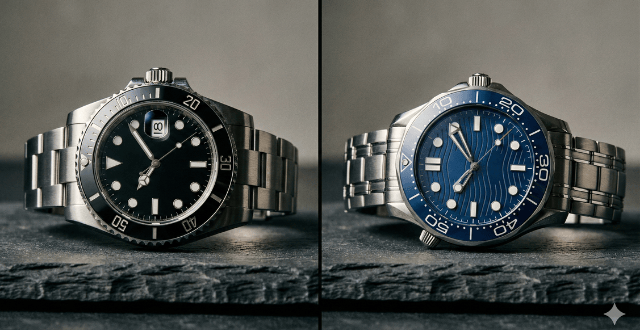
Dive Watches: Submariner vs Seamaster
Thinner profile, longer power reserve, superior value retention, iconic status, better proportions.
Superior magnetic resistance, lower acquisition cost, helium escape valve, wave-pattern dial, skeleton hands, easier availability.
Chronographs: Daytona vs Speedmaster
Automatic winding, higher water resistance, superior value retention, motorsport heritage, ceramic bezel, screw-down pushers.
Space exploration heritage (actual Moon watch), manual winding (purist appeal), dramatically lower price, hesalite crystal option (vintage authenticity), easier availability.
The price difference here is staggering. You could buy four Speedmasters for the secondary market price of one Daytona.
Everyday Watches: Datejust vs Aqua Terra
Slimmer case, Cyclops magnification, fluted bezel option, jubilee bracelet option, superior value retention.
Superior magnetic resistance, teak-pattern dial, more casual versatility, significantly lower price, higher water resistance.
Who Should Buy Rolex
Rolex makes sense if you:
Need a watch immediately, prioritise technical specifications over prestige, want variety without enormous investment, or view the purchase purely as a tool rather than an asset.
Who Should Buy Omega
Omega makes sense if you:
View watches primarily as investments, prioritise social recognition above all else, or want something that will certainly appreciate.
The Honest Assessment
After examining both brands objectively:
Unmatched value retention, superior brand recognition, exceptional build quality, and proven reliability. The constraint-based purchasing model, while frustrating, does create genuine exclusivity.
Superior technical specifications in many areas (magnetic resistance, third-party certification), more accessible pricing, easier purchasing, genuine space heritage, and excellent reliability.
They serve different priorities.
Much of Rolex's premium reflects brand positioning and scarcity rather than proportionally superior quality. A Rolex doesn't keep time twice as well as an Omega, it doesn't last twice as long, and it isn't finished twice as beautifully. But it does hold value better, and that matters to many collectors.
If you can get a Rolex at retail, it's actually cheaper to own than an Omega over time because it appreciates. If you can't, pre-owned Omega offers the best value in luxury watches.
Making Your Decision
Use this framework:
Budget-First Approach
Budget (S$)Recommended PathUnder $6,000Pre-owned Omega (Seamaster, Speedmaster, Aqua Terra)$6,000-10,000New Omega or pre-owned Rolex (Datejust, Oyster Perpetual)$10,000-15,000New Omega (any model) or Rolex at retail (if available)$15,000-25,000Rolex at retail (sport models) or premium OmegaOver $25,000Rolex secondary market or precious metal options
Priority-First Approach
Your PriorityRecommended BrandInvestment potentialRolexTechnical specificationsOmegaStatus recognitionRolexValue per dollarOmegaImmediate purchaseOmegaLong-term appreciationRolexCollection varietyOmegaExclusivityRolex
Use Case Approach
How You'll Use ItRecommendedDaily professional wearEither (Datejust or Aqua Terra)Active divingEither (Submariner or Seamaster)Motorsport associationRolex DaytonaSpace/aviation associationOmega SpeedmasterDress occasions onlyRolex (higher status signalling)Adventure/travelEither (GMT-Master II or Planet Ocean GMT)High magnetic environmentOmega (15,000 gauss resistance)
Pre-Purchase Checklist
Before committing to either brand:
For Rolex:
For Omega:
For more guidance on pre-owned purchases, see 9 costly red flags to watch for when buying pre-owned.
FAQ
Is Omega as good as Rolex?
In terms of mechanical quality, yes. Both brands produce excellent movements with high accuracy, reliability, and finishing. Omega's Master Chronometer certification actually exceeds Rolex's Superlative Chronometer in magnetic resistance testing (15,000 vs ~1,000 gauss). The difference lies in brand perception, value retention, and market dynamics rather than objective quality.
Do Omega watches hold their value?
Omega watches typically depreciate 30-40% from retail price on the secondary market, then stabilise. This is normal for most watch brands. Rolex is the exception, not the rule. Pre-owned Omega purchases largely avoid this depreciation and represent excellent long-term value.
Why is Rolex so expensive compared to Omega?
Rolex prices reflect brand positioning, controlled supply, and market demand rather than proportionally higher manufacturing costs or quality. Rolex has successfully positioned itself as the default luxury watch, creating demand that exceeds supply. This scarcity (whether natural or artificial) drives prices above what pure specifications would justify.
Can I negotiate on Rolex or Omega prices?
Rolex retail prices are fixed with no negotiation possible. Omega offers more flexibility, with authorised dealers sometimes offering modest discounts, and grey market dealers typically selling 10-20% below retail. Pre-owned prices for both brands are always negotiable.
Which brand has better resale value?
Rolex, definitively. Most Rolex sport models trade at or above retail on the secondary market. Most Omega models trade 30-40% below retail. If resale value is a primary concern, Rolex is the clear choice.
How often do Rolex and Omega need servicing?
Rolex recommends service approximately every 10 years for modern movements. Omega recommends service every 5-8 years. Both warranties cover 5 years from purchase. Service costs are similar: S$800-1,500 depending on model complexity.
Which brand is better for a first luxury watch?
Omega offers lower entry prices, easier availability, and excellent quality, making it ideal for first-time luxury watch buyers. Rolex requires either patience (waiting for allocation) or premium payments (grey market), which may be frustrating for first purchases.
Are Rolex and Omega competitors?
Historically yes, but Rolex has moved upmarket while Omega competes more directly with Tudor (Rolex's sister brand) at similar price points. Rolex sport models now trade at prices that compete with Audemars Piguet and Patek Philippe entry-level pieces rather than Omega.
MINT Conclusion
Both Rolex and Omega produce exceptional timepieces worthy of any collection. Rolex offers unmatched value retention and status signalling. Omega offers superior technical specifications and accessibility. Your choice depends on whether you prioritise your watch as an investment or as a tool, whether you need immediate gratification or can wait years for an allocation, and whether brand recognition or technical excellence matters more to you.
Whichever brand you choose, you're acquiring a significant asset that deserves appropriate protection. A watch worth S$10,000, S$20,000, or S$50,000 represents real financial exposure to theft, loss, or accidental damage. Standard home insurance often provides inadequate coverage for luxury watches, and many collectors are surprised to discover their prized timepiece isn't fully protected.
MINT provides specialist watch insurance designed specifically for Singapore collectors, covering your Rolex or Omega against the risks that neither brand's warranty addresses: theft, loss, and accidental damage anywhere in the world.
For more information, see watch insurance Singapore or how to insure your Rolex.
Protect Your Watch Collection
Own a luxury timepiece? Make sure it's properly protected. MINT provides specialist watch insurance in Singapore covering theft, loss, and accidental damage worldwide. From $8/month for comprehensive coverage trusted by Singapore collectors.
- Watch Insurance Singapore – Complete coverage guide
- How to Insure Your Rolex – Step-by-step guide
- Dealer Insurance – For watch businesses
Read other articles