Rolex Submariner vs Omega Seamaster: Complete Comparison

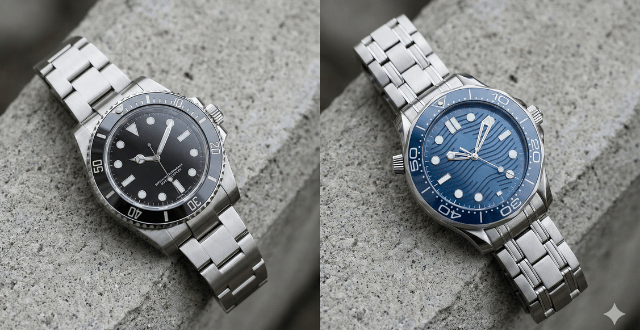
The Rolex Submariner and Omega Seamaster Diver 300M represent two approaches to the same problem: building the definitive dive watch. One costs nearly three times as much as the other. One carries a waitlist measured in years. One offers more technical specifications on paper.
The question isn't which watch is better. It's which watch is better for you, given your priorities, budget, and what you actually want from a dive watch.
This guide covers:
- Complete specification comparison across every measurable dimension
- Movement technology and what the differences mean in practice
- Value retention, availability, and total cost of ownership
- Build quality, finishing, and materials
- Who should buy each watch based on specific priorities
Submariner vs Seamaster: Specifications Compared
| Specification | Rolex Submariner 126610LN | Omega Seamaster 300M |
|---|---|---|
| Case diameter | 41mm | 42mm |
| Thickness | 12.5mm | 13.5mm |
| Water resistance | 300m | 300m |
| Movement | Calibre 3235 | Calibre 8800 |
| Power reserve | 70 hours | 55 hours |
| Accuracy | -2/+2 sec/day (COSC) | 0/+5 sec/day (METAS) |
| Crystal | Sapphire | Sapphire |
| Bezel | Ceramic (Cerachrom) | Ceramic |
| Lume | Chromalight (blue) | Super-LumiNova |
| Bracelet | Oyster with Glidelock | Steel with micro-adjust |
| Retail Price (S$) | ~19,000 | ~8,500 |
| Secondary Market (S$) | 15,500-17,500 | 6,000-7,500 |
| Value Retention | Excellent (at/above retail) | Good (70-85%) |
| Availability | Waitlist 1-3 years | Immediate |
Which Should You Choose?
| If You Prioritise... | Choose | Why |
|---|---|---|
| Resale value | Submariner | Trades at/above retail consistently |
| Value for money | Seamaster | 55% cheaper, similar specs |
| Immediate purchase | Seamaster | No waitlist, buy today |
| Brand prestige | Submariner | Stronger brand recognition |
| Technology | Seamaster | METAS certification, co-axial escapement |
| Slimmer profile | Submariner | 1mm thinner |
| Heritage | Submariner | Original luxury dive watch (1953) |
The Watches at a Glance
Before examining details, here's the fundamental comparison:
| Attribute | Rolex Submariner Date (126610LN) | Omega Seamaster Diver 300M |
|---|---|---|
| Retail Price | S$13,500 | S$7,300 (bracelet) / S$6,600 (rubber) |
| Secondary Market | S$14,000–S$17,000 | S$5,200–S$6,000 |
| Availability | 2–5 year waitlist at authorised dealers | Generally available |
| Case Size | 41mm | 42mm |
| Water Resistance | 300m | 300m |
| Movement | Calibre 3235 (in-house) | Calibre 8800 (in-house) |
| Power Reserve | 70 hours | 55 hours |
| Magnetic Resistance | 1,000 gauss (Parachrom hairspring) | 15,000 gauss (Master Chronometer) |
| Year Introduced | 2020 (current generation) | 2018 (current generation) |
Both watches achieve their stated purpose: professional-grade dive instruments that function flawlessly in everyday wear. The differences lie in approach, positioning, and what each brand prioritises.
Specification Deep Dive
Case and Dimensions
| Specification | Rolex Submariner 126610LN | Omega Seamaster 300M |
|---|---|---|
| Diameter | 41mm | 42mm |
| Thickness | 12.3mm | 13.5mm |
| Lug-to-lug | 48mm | 50mm |
| Lug width | 21mm | 20mm |
| Case material | 904L Oystersteel | 316L stainless steel |
| Crystal | Sapphire with Cyclops (AR on underside) | Domed sapphire (AR both sides) |
| Caseback | Solid, screw-down | Exhibition, sapphire |
What these differences mean:
The Submariner wears more compactly despite similar diameter. At 12.3mm thick versus 13.5mm, it slides under shirt cuffs more easily. The shorter lug-to-lug (48mm vs 50mm) suits smaller wrists better.
Rolex uses 904L steel, which is more corrosion-resistant and takes a higher polish than standard 316L. The practical difference is subtle, but 904L maintains its finish longer in salt water and humid environments.
The Seamaster's exhibition caseback lets you view the decorated movement. The Submariner's solid caseback offers marginally better pressure resistance and a cleaner aesthetic for those who prefer it.
Bezel and Dial
| Feature | Rolex Submariner 126610LN | Omega Seamaster 300M |
|---|---|---|
| Bezel material | Cerachrom ceramic | Ceramic with enamel or Ceragold |
| Bezel action | 120 clicks, unidirectional | 60 clicks, unidirectional |
| Dial material | Oystersteel with lacquer | Ceramic with laser-engraved waves |
| Date position | 3 o'clock with Cyclops | 6 o'clock (colour-matched wheel) |
| Lume type | Chromalight (blue glow) | Super-LumiNova (green glow) |
| Helium escape valve | No | Yes, at 10 o'clock |
Practical observations:
The Submariner's 120-click bezel allows more precise timing in 30-second increments. The Seamaster's 60-click bezel operates in full-minute increments only. For actual diving, this rarely matters. For daily timing use, the Submariner offers finer resolution.
The Seamaster's wave-pattern dial is distinctive and polarising: you either love it or find it too busy. The Submariner's clean dial is more conservative and versatile across dress codes.
The helium escape valve on the Seamaster serves saturation divers who decompress in hyperbaric chambers. For recreational diving and everyday wear, it's functionally unnecessary but adds to the tool-watch aesthetic.
Movement Comparison
This is where the comparison becomes nuanced. Both movements are exceptional, but they achieve excellence differently.
| Specification | Rolex Calibre 3235 | Omega Calibre 8800 |
|---|---|---|
| Type | Automatic, in-house | Automatic, in-house |
| Frequency | 28,800 vph (4Hz) | 25,200 vph (3.5Hz) |
| Power reserve | 70 hours | 55 hours |
| Jewels | 31 | 35 |
| Escapement | Chronergy (optimised Swiss lever) | Co-Axial |
| Hairspring | Parachrom (paramagnetic) | Silicon (antimagnetic) |
| Magnetic resistance | ~1,000 gauss | 15,000 gauss |
| Shock protection | Paraflex | Standard INCABLOC-type |
| Certification | COSC + Rolex Superlative Chronometer (±2 sec/day) | COSC + METAS Master Chronometer (0/+5 sec/day) |
| Display caseback | No | Yes |
Movement technology explained:
Rolex's Calibre 3235 represents evolutionary refinement of traditional Swiss watchmaking. The Chronergy escapement improves efficiency over standard lever escapements, contributing to the 70-hour power reserve. The Parachrom hairspring resists magnetic fields up to approximately 1,000 gauss, sufficient for most real-world exposure.
Omega's Calibre 8800 uses the Co-Axial escapement developed by legendary watchmaker George Daniels. This design reduces friction between escapement components, theoretically extending service intervals. The silicon hairspring provides resistance to magnetic fields up to 15,000 gauss, exceeding any magnetic exposure you'd encounter in daily life.
Which movement is "better"?
Neither. Both keep excellent time and will run reliably for years between services. The Rolex offers more power reserve. The Omega offers greater magnetic resistance. In practice, you'll rarely drain a 55-hour power reserve or encounter magnetic fields above 1,000 gauss. Choose based on other factors.
Bracelet and Clasp
| Feature | Rolex Submariner 126610LN | Omega Seamaster 300M |
|---|---|---|
| Bracelet type | Oyster (3-link) | 5-link with polished centre |
| Clasp type | Oysterlock with Glidelock | Fold-over with push-button release |
| Micro-adjustment | Glidelock (2mm increments, 20mm total) | Diver extension + push-button adjustment |
| Bracelet taper | 21mm to 18mm | 20mm to 16mm |
| Link adjustment | Screw pins | Screw pins |
Practical differences:
The Rolex Glidelock system is the benchmark for on-wrist adjustment. You can extend or reduce the bracelet by 2mm increments without tools, accommodating wrist swelling in heat or over a wetsuit. It's the single best micro-adjustment system available.
The Seamaster's adjustment system is functional but less refined. The push-button release works well; the diver extension adds length for wetsuit use. It accomplishes the same goals with slightly more effort.
The Submariner's Oyster bracelet is austere and sporty. The Seamaster's polished centre links add visual interest but show scratches more readily.
Value Retention and Resale
This is where the watches diverge most dramatically.
| Metric | Rolex Submariner 126610LN | Omega Seamaster 300M |
|---|---|---|
| Retail price | S$13,500 | S$7,300 |
| Secondary market (excellent condition) | S$14,000–S$17,000 | S$5,200–S$6,000 |
| Premium/discount to retail | +4% to +26% | -18% to -29% |
| 5-year value retention | ~100%+ | ~70–80% |
| Liquidity (time to sell) | Days | 2–4 weeks |
| Demand trend | Consistently strong | Stable |
What this means financially:
The Submariner functions as a store of value. If you buy at retail (assuming you can), you own an asset worth more than you paid. Even buying at grey market prices, value holds well over time.
The Seamaster follows typical luxury watch depreciation. Buying new means accepting 20–30% value loss. However, this creates opportunity: buying pre-owned at S$5,000–S$5,500 represents excellent value for a current-generation luxury dive watch.
For detailed analysis of which watches hold value, see our guide to investment-grade watches.
Availability and Purchase Experience
| Factor | Rolex Submariner | Omega Seamaster |
|---|---|---|
| Authorised dealer availability | Waitlist 2–5 years | Generally in stock |
| Grey market availability | Abundant at premium | Abundant at discount |
| Purchase experience | Relationship required | Walk in and buy |
| Allocation games | Common | None |
The Rolex experience:
Getting a Submariner at retail requires building purchase history with an authorised dealer, waiting years, and accepting that allocation is never guaranteed. Many buyers find this process frustrating or demeaning. Others view it as part of the brand's exclusivity.
The alternative is paying grey market premiums of S$2,000–S$5,000 above retail for immediate availability. This eliminates the wait but reduces value proposition.
For current Rolex waitlist information, see our comprehensive waiting list guide.
The Omega experience:
Walk into any Omega boutique or authorised dealer. Try on the watch. If you like it, buy it. The transaction is straightforward, respectful, and completed in a single visit.
For many buyers, this accessibility is a feature, not a bug. The ability to buy what you want, when you want it, without games or waiting, has real value.
Total Cost of Ownership
Beyond purchase price, ownership costs differ:
| Cost Category | Rolex Submariner | Omega Seamaster |
|---|---|---|
| Service interval | 10 years recommended | 5–8 years recommended |
| Service cost (authorised) | S$800–S$1,200 | S$600–S$900 |
| Service cost (independent) | S$400–S$700 | S$300–S$500 |
| Insurance (annual, agreed value) | S$135–S$170 (1% of S$13,500–S$17,000) | S$55–S$75 (1% of S$5,500–S$7,500) |
| Depreciation (5 years, bought new) | S$0 or appreciation | S$1,500–S$2,500 |
10-year ownership cost comparison:
| Component | Rolex Submariner (retail) | Omega Seamaster (retail) | Omega Seamaster (pre-owned) |
|---|---|---|---|
| Purchase | S$13,500 | S$7,300 | S$5,500 |
| Services (one cycle each) | S$1,000 | S$750 | S$750 |
| Insurance (10 years) | S$1,500 | S$700 | S$550 |
| Resale value | (S$14,000) | (S$5,000) | (S$4,500) |
| Net cost | S$2,000 | S$3,750 | S$2,300 |
The Submariner, bought at retail, actually generates positive return over 10 years when accounting for appreciation. The Seamaster's depreciation makes ownership more expensive despite lower entry price.
However, buying a pre-owned Seamaster at market price (S$5,500) changes the equation dramatically, achieving similar net cost to the Submariner without waitlists or allocation requirements.
For comprehensive insurance information, see watch insurance in Singapore and how to insure your Rolex.
Build Quality and Finishing
Both watches exhibit excellent build quality appropriate to their price points. The differences are matters of degree, not kind.
Where Rolex Excels
Case finishing consistency: Rolex's brushed surfaces are uniform to a degree that borders on obsessive. Transitions between brushed and polished elements are laser-sharp.
Bracelet engineering: The Oyster bracelet has minimal lateral play between links. The Glidelock clasp operates with mechanical precision that sets the industry standard.
Crown operation: The Triplock crown threads with smooth, consistent resistance. The sealed feeling when fully screwed is unmistakable.
Attention to detail: Examine a Submariner under magnification and you'll find nothing to criticise. Every element is executed to the same standard.
Where Omega Excels
Movement decoration: The Calibre 8800's Geneva waves, bevelled edges, and rhodium plating are visible through the exhibition caseback. Rolex movements are equally well-finished but hidden.
Dial complexity: The laser-engraved wave pattern on the ceramic dial represents technical achievement. The execution is flawless regardless of whether you prefer the aesthetic.
Material innovation: Omega pioneered ceramic dials in this price segment and continues experimenting with materials like Sedna gold and Ceragold.
Technical specifications: Master Chronometer certification, 15,000-gauss magnetic resistance, and the Co-Axial escapement represent genuine horological advancement.
Honest Assessment
If you examine both watches side by side without brand preconceptions, the Rolex justifies some, but not all, of its price premium through finishing quality. Whether it justifies a 2–3x price difference depends on how much you value incremental improvements in execution.
The Omega is not a "budget" alternative. It's a properly executed luxury dive watch that makes different choices about where to invest manufacturing effort.
Who Should Buy Each Watch
Choose the Rolex Submariner if:
| Priority | Why Submariner |
|---|---|
| Value retention matters | Only mainstream watch that reliably holds or appreciates |
| You have access to retail | No waitlist concerns eliminate grey market premium |
| You prefer understated design | Cleaner dial, more conservative aesthetic |
| You value resale liquidity | Sells in days at predictable prices |
| Brand recognition is important | Most recognised luxury watch globally |
| You want "the original" | Submariner defined the dive watch category |
Choose the Omega Seamaster if:
| Priority | Why Seamaster |
|---|---|
| Immediate availability | Buy today without waitlist or games |
| Budget is constrained | S$5,500–S$7,300 vs S$13,500–S$17,000 |
| Technical specs matter | Superior magnetic resistance, exhibition caseback |
| You prefer distinctive design | Wave dial stands out from Submariner-inspired watches |
| You're buying pre-owned | Excellent value at secondary market prices |
| You reject allocation culture | Straightforward purchase experience |
Consider Alternatives if:
| Situation | Alternative |
|---|---|
| Want Rolex quality at lower price | Tudor Black Bay (S$5,000–S$6,500) |
| Want Omega specs with heritage | Omega Speedmaster Professional (S$8,500–S$9,500) |
| Prioritise pure value | Grand Seiko SBGA211 or similar (S$6,500–S$8,000) |
| Need true professional dive watch | Omega Planet Ocean 600M (S$9,000–S$11,000) |
Common Questions Addressed
"Is the Rolex worth three times the price?"
Not in terms of pure functionality or even finishing quality. The Seamaster does everything the Submariner does, keeps time to similar accuracy, and will last equally long with proper service.
The Submariner's premium buys: brand recognition, value retention, exclusivity, resale liquidity, and incremental finishing advantages. Whether those factors justify S$6,000–S$10,000 in additional cost is subjective.
"Will the Omega feel like a compromise?"
No. The Seamaster stands on its own merits as a luxury dive watch. You'll only feel it's a compromise if you specifically wanted a Submariner but couldn't get one. If you're choosing the Seamaster because you prefer it, there's nothing compromised about the decision.
"Which is better for daily wear?"
Both are excellent daily wearers. The Submariner's slimmer profile (12.3mm vs 13.5mm) slides under cuffs more easily. The Seamaster's exhibition caseback offers visual interest when removed. The Submariner's Glidelock adjusts more easily to temperature changes. The Seamaster's rubber strap option provides casual versatility.
"Which holds up better over time?"
Both. Rolex's 904L steel resists corrosion marginally better. Omega's ceramic dial is virtually scratchproof. Both bracelets will develop wear patterns over years of use. Both movements will require service eventually. Neither is meaningfully more durable than the other.
"Can I get the Seamaster serviced anywhere?"
Omega service is widely available through authorised service centres and qualified independent watchmakers. Rolex service is more restrictive, with Rolex preferring (and sometimes requiring) authorised service centres to maintain warranty coverage.
Pre-Purchase Checklist
Before purchasing either watch:
For New Purchases
- Confirmed availability and waitlist status (Rolex) or stock (Omega)
- Verified authorised dealer credentials
- Understood warranty terms and duration
- Inspected watch in person before committing
- Confirmed all documentation will be provided
For Pre-Owned Purchases
- Verified authenticity through inspection or professional authentication
- Confirmed serial numbers match across documentation and watch
- Assessed condition against asking price
- Understood service history and any work needed
- Verified complete set (box, papers, accessories) if claimed
For authentication guidance, see 9 costly red flags when buying pre-owned watches.
Post-Purchase
- Photographed and documented the watch
- Stored documentation separately from watch
- Arranged appropriate insurance coverage
- Established secure storage solution
For storage guidance, see our collector's guide to watch storage and security.
FAQ
Which watch is more accurate?
Both are certified chronometers and perform within similar tolerances: ±2 seconds per day for the Rolex Superlative Chronometer standard, 0 to +5 seconds per day for the Omega METAS Master Chronometer standard. In practice, both keep time accurately enough that you'll rarely notice any deviation.
Which movement lasts longer between services?
Rolex recommends service every 10 years. Omega recommends service every 5–8 years, though the Co-Axial escapement theoretically reduces wear. Real-world longevity depends more on use patterns and environmental exposure than movement design. Both will run reliably for their recommended intervals.
Can I swim with both watches?
Yes. Both are rated to 300m water resistance and designed for diving. Swimming, snorkelling, and recreational diving are well within their capabilities. Ensure crowns are properly screwed down before water exposure.
Which is better for small wrists?
The Submariner. At 41mm diameter, 48mm lug-to-lug, and 12.3mm thickness, it wears more compactly than the Seamaster's 42mm diameter, 50mm lug-to-lug, and 13.5mm thickness. The differences are modest but noticeable on wrists under 17cm circumference.
Do I need the helium escape valve on the Seamaster?
For recreational diving and daily wear, no. The helium escape valve serves saturation divers who spend extended periods in hyperbaric chambers where helium can infiltrate the case. For normal use, it's a historical design element rather than a functional necessity.
Which watch has better resale value?
The Submariner, definitively. It trades above retail price and sells within days. The Seamaster trades 20–30% below retail and takes 2–4 weeks to sell. If resale value is a priority, the Submariner is the clear choice.
Can I buy either watch online safely?
Yes, from reputable sources. For new watches, buy only from authorised dealers. For pre-owned, established platforms like Chrono24 (with escrow) or reputable dealers with physical premises and return policies offer reasonable protection. Avoid private sales without authentication and escrow.
Which watch is better for formal occasions?
The Submariner's cleaner dial and slimmer profile make it marginally more versatile across dress codes. The Seamaster's wave dial and helium escape valve read more casually. That said, both are sport watches, and neither is truly "formal" in the way a dress watch would be. Both work with business casual and smart casual attire.
MINT Conclusion
Whether you choose the Submariner's proven value retention or the Seamaster's accessible excellence, you're acquiring a luxury timepiece worth protecting properly.
The Submariner's S$14,000+ secondary market value represents significant financial exposure: theft, loss, or accidental damage could mean substantial uninsured loss. The Seamaster's S$5,500–S$7,300 value, while lower, still exceeds typical home insurance single-item limits.
MINT provides specialist watch insurance designed for luxury timepieces at both price points. Coverage reflects current market value, not depreciated purchase price, and protects against the full range of risks that come with owning and wearing valuable watches daily. Whichever watch suits your priorities, appropriate insurance ensures you can enjoy it without worrying about what might go wrong.
Disclaimer: Prices, specifications, and availability reflect conditions at time of publication and may change. This content is informational only and does not constitute financial or professional advice. Always conduct independent research before purchasing.
FAQ
Is the Rolex Submariner worth the price premium over the Seamaster?
The Submariner costs roughly double the Seamaster. If resale value and brand prestige matter most, the premium is justified. If you prioritise technical specifications and immediate availability, the Seamaster offers better value.
Which watch holds value better: Submariner or Seamaster?
The Submariner significantly outperforms the Seamaster for value retention. Submariners often sell at or above retail on the secondary market. Seamasters typically trade at 70-85% of retail, though this still represents good value retention compared to most luxury watches.
Can I buy a Rolex Submariner without a waitlist?
New Submariners from authorised dealers require waitlists of 1-3 years in Singapore. Pre-owned examples are readily available but trade at premiums. The Seamaster can be purchased immediately from any Omega boutique or authorised dealer.
Which is better for daily wear?
Both are excellent daily wearers built for durability. The Seamaster is marginally easier to wear without attracting unwanted attention. The Submariner's prestige can make some owners uncomfortable wearing it daily.
Which movement is more accurate?
The Omega Seamaster with METAS certification offers tighter accuracy tolerances (0/+5 sec/day) versus Rolex's COSC certification (-2/+2 sec/day). In practice, both keep excellent time and the difference is negligible for daily wear.
Should I buy both?
Many collectors own both as they serve slightly different roles. The Seamaster makes an excellent entry into luxury dive watches, while the Submariner represents the pinnacle of the category. Starting with the Seamaster lets you evaluate whether the Submariner premium is worthwhile.
Protect Your Watch Collection
Own a luxury timepiece? Make sure it's properly protected. MINT provides specialist watch insurance in Singapore covering theft, loss, and accidental damage worldwide. From $8/month for comprehensive coverage trusted by Singapore collectors.
- Watch Insurance Singapore – Complete coverage guide
- How to Insure Your Rolex – Step-by-step guide
- Dealer Insurance – For watch businesses
Read other articles